

Table of Contents
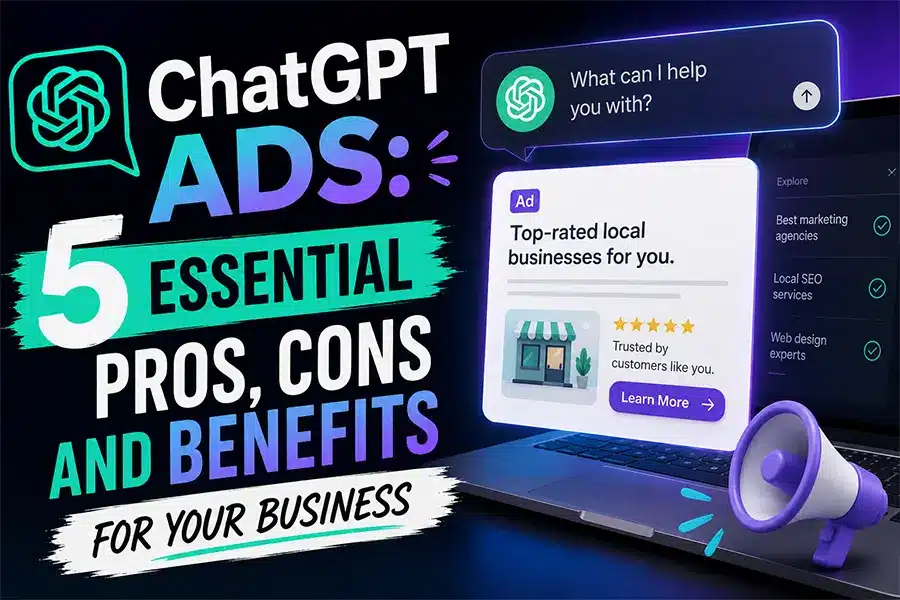
OpenAI just gave every business with a website and a credit card a new place to advertise and unlike Google Ads or Meta, this one can write the first draft of your campaign for you. ChatGPT Ads went from a limited test to a fully self-serve, no-minimum-spend platform in about five months this year, and business owners are already asking the question that matters most: is this worth a slice of the marketing budget, or is it too early to bother? Here’s what ChatGPT Ads actually are, the real pros and cons, and how to decide if your business should be one of the early movers.
What Are ChatGPT Ads, and How Do They Actually Work?
These ads are paid, sponsored placements that appear as a labeled card underneath ChatGPT’s normal response never inside the AI’s own written answer. When someone asks ChatGPT for a recommendation, a comparison, or advice on something you sell, a relevant ad can appear alongside that answer, targeted using the context of the conversation itself rather than a list of keywords you bid on.
Getting started is simple by design. You add your website URL, and Ads Manager can help prefill suggested ad details for you to review, edit, and launch — pulling your business name, a description, and creative suggestions directly from your site instead of making you build a campaign from a blank form. You still set your own budget, choose CPC or CPM bidding, and approve everything before it goes live.
The Benefits of Advertising on ChatGPT
For the right business, this platform offers a few real advantages that Google Ads and Meta don’t:
- You’re reaching people while they’re actively deciding. ChatGPT Ads can help your business reach people as they discover products and services, compare options, and decide what to do next, that’s a warmer, more research-ready audience than a cold social feed.
- Low barrier to entry. There’s no minimum spend and no agency requirement. Any U.S. business can set a daily budget as low as roughly $20 and start testing the same day.
- Less competition, for now. Because the ad auction is new, cost-per-click is often lower than in a mature, crowded platform similar to how early Google Ads and early Facebook Ads advertisers benefited from cheaper clicks before every competitor showed up.
- It doesn’t feel like an ad. Placement inside a conversational recommendation reads more like a suggestion than a banner, which tends to earn more trust from someone who’s already asking a real question.
ChatGPT Ads: Pros and Cons at a Glance
Here’s how the platform stacks up right now for a typical small or mid-sized business:
| Category | The Pro | The Con |
|---|---|---|
| Cost to Start | No minimum spend; test for as little as ~$20/day | CPC often runs $3–$5, which adds up fast without a tracked goal |
| Audience Quality | People are already comparing options, not just scrolling | Total reach is still far smaller than Google or Meta |
| Targeting | Matches based on real conversation context, not guesswork | No hyperlocal or detailed demographic targeting yet |
| Setup Effort | Ads Manager prefills your ad from your website URL | Prefilled details still need editing — auto-fill is a draft, not a finished ad |
| Measurement | Conversions API and pixel tracking are now available | Reporting is newer and less mature than Google Ads or Meta Ads Manager |
How a ChatGPT Ads Campaign Actually Comes Together
The setup flow is one of the platform’s biggest selling points. Here’s the path from zero to a live campaign:
What’s Changed With ChatGPT Ads Just This Month
This space is moving fast enough that “current” changes by the week. OpenAI’s ads program started narrowly in February 2026 as sponsored cards for free-tier users, then opened a self-serve beta in May with CPC bidding, no minimum spend, and Conversions API support. As of this month, OpenAI has widened self-serve access further, adding pixel-based measurement and pointing to early case studies from larger advertisers as proof the format converts reporting on the rollout from marketing publications including Segwise and EasyInsights notes that contextual targeting, not keyword bidding, is the core mechanic advertisers need to learn. The practical takeaway for a small business: the tooling is real and usable today, but it’s still early enough that best practices are being written in real time.
Where ChatGPT Ads Fall Short Right Now
They aren’t a replacement for your existing channels yet, and treating them like one is the most common early mistake. The targeting is contextual rather than demographic or hyperlocal, so a business that depends on “people within 10 miles of my shop” targeting won’t get the precision Google Local Services Ads or Meta’s location targeting already provide. Total reach is also still a fraction of Google or Meta simply because fewer people use ChatGPT than use Google Search or Instagram in a given day.
The format also rewards businesses that sell something people research before buying — services, software, education, higher-consideration purchases more than businesses selling low-cost, impulse, or highly visual products where a photo does more work than a paragraph of AI-generated recommendation text.
Is ChatGPT Advertising Right for Your Business?
If you run a professional service, a B2B company, or a business with an average client value in the thousands of dollars, ChatGPT Ads are worth a small test budget now while competition and cost-per-click are still low. If you run a hyperlocal, walk-in retail, or visually driven business, your marketing dollars are still better spent on a tightly optimized Google Business Profile and a strong local SEO foundation before adding a newer, smaller-reach paid channel on top.
Either way, they work best as one piece of a bigger AI visibility strategy not a replacement for it. The same structured, accurate business information that helps you rank in AI-generated answers is what any future ChatGPT ad campaign will also draw from when it prefills your details.
What to Do Before You Launch Your First Campaign
A little preparation goes a long way with a platform this new:
- Clean up your website’s core pages first. Ads Manager prefills your ad from your site, so vague or outdated copy on your homepage becomes a vague or outdated ad.
- Set a small test budget with a real goal attached a form fill, a call, or a booked consultation — not just impressions or clicks.
- Make sure your technical SEO and tracking are in order before you turn on the Conversions API or pixel, so the data you collect from day one is actually usable.
- Treat your first two weeks as a test, not a verdict. Early auction dynamics change fast on a brand-new ad platform, and this month’s cost-per-click won’t be next quarter’s.
If you’d rather have someone who tracks these platform changes daily handle the setup, our AI search optimization services cover exactly this kind of new-channel testing alongside your existing SEO and GBP work.
Frequently Asked Questions
1. How much do ChatGPT Ads cost?
There’s no minimum spend. Cost-per-click has generally run in the $3–$5 range, with cost-per-thousand-impressions pricing available as an alternative depending on your goal and targeting.
2. Do I need an agency or ad account manager to run ChatGPT Ads?
No. The self-serve Ads Manager is open to any U.S. business with a website and a credit card no agency requirement and no minimum ad spend to get started.
3. Will ChatGPT Ads change what the AI actually recommends?
No. Ads appear as a clearly labeled sponsored card separate from ChatGPT’s own written response, and they don’t influence the answer itself.
4. Is ChatGPT advertising better than Google Ads?
Not better or worse — different. Google Ads still has far greater reach and mature, granular targeting. ChatGPT Ads currently offer lower competition and a more conversational, research-stage audience, making the two channels complementary rather than interchangeable.
5. What businesses should skip ChatGPT Ads for now?
Hyperlocal businesses that depend on tight geographic targeting, and highly visual or impulse-purchase retailers, are likely to see a better return from other channels until ChatGPT’s targeting and reach mature further.
6. How do I know if my ad is actually converting?
Connect the Conversions API or install the tracking pixel before you launch, and define one clear conversion goal a call, a form, or a booking so you can judge results against a real business outcome instead of clicks alone.
Ready to Test ChatGPT Ads the Right Way?
FOG Digital Marketing cleans up your website and tracking so a ChatGPT Ads campaign has real data to work with from day one, and helps you set up conversion tracking so you know what’s actually working.
Our Blog
Website Design Blogs
WordPress 7.1.3 Fixes 7 Holes: Update Your Site Now
WordPress 7.1.3 Fixes 7 Holes: Update Your Site Now October 20, 2026 Web Design Table of Contents WordPress 7.1.3 fixes seven security holes, and the WordPress team says...

Can an AI Website Builder Build My Business Site?
Can an AI Website Builder Build My Business Site? September 9, 2026 Web Design Table of Contents Yes, an AI website builder can produce a working business website...

Core Web Vitals: Why Slow Sites Are Losing Rankings
Core Web Vitals 2026: Why Slow Sites Are Losing Rankings July 7, 2026 Web Design Table of Contents If your website takes more than 2.5 seconds to show...