

Table of Contents
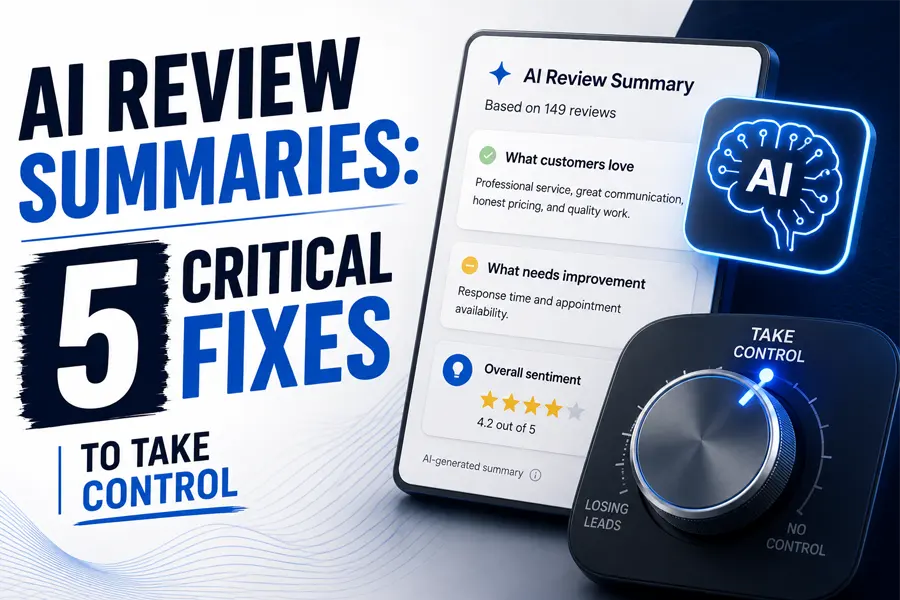
Google is now writing a short AI summary of your reviews and putting it above the actual reviews, and if your customers never mention what makes you good at your job, that summary will be generic enough to send them straight to a competitor. This is not a future feature. AI review summaries are already live on Google Business Profiles and Google Maps, built with Gemini, and shown to most searchers before they ever scroll down to read a single review themselves.
For years the advice was simple: get more reviews, get more stars, respond to the bad ones. That still matters. But AI review summaries change what happens the moment someone lands on your profile. Instead of skimming ten reviews and forming their own opinion, they read one AI-written paragraph that decides, in a few sentences, what your business is known for. If that paragraph is vague or focused on the wrong thing, you lose the customer before they ever see your photos, your hours, or your actual reviews.
What AI Review Summaries Are, and Why They Now Come First
AI review summaries are short paragraphs, generated by Google’s Gemini AI, that sit at the top of the reviews section on a Google Business Profile or Google Maps listing. Google labels them “Summarized with Gemini” and pulls the content entirely from the language your customers actually used in their reviews. The feature moved from limited testing to general availability in 2026, and it now appears on business listings across most categories, from restaurants to home services to medical offices.
The summary usually covers three to five themes, things like service speed, staff friendliness, pricing, or product quality, based on what shows up most often in your reviews. Google has also rolled out a related feature called “Know Before You Go,” which uses the same review data to answer specific questions before someone visits, like whether a business is loud, whether there’s parking, or how long the wait tends to run.
The practical effect is simple: AI review summaries are now the first thing a lot of potential customers read about you, ahead of your description, ahead of your photos, and ahead of the reviews themselves.
How Google Builds the Summary From What Customers Actually Write
Google’s AI review summaries are not written by Google’s marketing team, and they are not written by you. They’re generated by scanning the actual text of your reviews and pulling out the phrases and topics that repeat most often. If ten customers mention “fast response time,” that becomes a theme in the summary. If nobody mentions your 15 years in business or your specialty service, the AI has nothing to work with and leaves it out, no matter how true it is.
That means the AI review summary is a mirror of your review content, not your marketing message. A business with 200 reviews that all say some version of “good service, fair price” gets a flat, forgettable summary. A business whose reviews mention specific services, specific staff members, and specific results gets a summary that actually sells.
5 Fixes to Make Sure the AI Summary Works in Your Favor
You can’t edit an AI review summary directly. What you can do is influence the raw material it’s built from. These five fixes give you the most control over what Google’s AI decides to say about your business.
- Ask for reviews that mention specifics, not just stars. When you follow up with a customer, ask a direct question like “What part of the service stood out to you?” instead of just “Leave us a review.” Reviews that name a specific service, product, or staff member give the AI more to summarize accurately.
- Respond to every review with real detail. Google’s AI reads your responses along with the reviews themselves. A generic “Thanks for the feedback!” adds nothing. A response that references the actual service performed reinforces the themes you want the summary to pick up.
- Fix the pattern, not just the review. If three recent reviews mention slow response times, that complaint is likely to surface in the AI review summary before you ever fix the underlying problem. Treat a repeated complaint as a signal the AI will amplify, not just one bad review to move past.
- Keep review volume steady, not just high. Google’s AI review summaries appear to weight recent reviews more heavily than old ones. A business that collected 40 reviews two years ago and none since gets summarized differently than one bringing in a handful of detailed reviews every month.
- Audit your own summary monthly. Search your business by name on a phone, screenshot what the AI summary says, and check it against how you actually want to be positioned. If it’s emphasizing the wrong thing, that tells you exactly what kind of reviews to start asking for next.
What Customers Write vs. What the AI Summary Tells New Customers
The gap between a vague review and a specific one is the difference between an AI review summary that sells you and one that says nothing at all.
| What the Customer Wrote | What Google’s AI Pulls Out | What a New Customer Sees First |
|---|---|---|
| “Great service, would recommend.” | Generic positive sentiment, no clear theme | A vague, forgettable summary line |
| “Fixed our AC same day, technician explained everything.” | Speed of service, clear communication | “Customers highlight fast response and clear communication.” |
| “Front desk was rude and made us wait 40 minutes.” | Repeated complaint flagged as a pattern | A caution surfaced in the summary if it repeats |
| “Best price I found for a custom logo, delivered in 3 days.” | Pricing and turnaround time | “Reviewers mention competitive pricing and fast turnaround.” |
How an AI Review Summary Actually Gets Built
It helps to see the process as a straight line from what your customer types to what your next customer reads.
Customer Leaves a Review
They describe their experience in their own words.
Gemini Scans the Language
Google’s AI reads every review for repeated themes.
Google Builds the Summary
The most common themes become a short AI paragraph.
New Customers Read It First
The summary appears before they see your actual reviews.
What Happens If You Ignore This
Ignoring AI review summaries does not mean nothing happens. Google is generating one for your business right now whether you engage with it or not, built entirely from whatever reviews already exist. If your review history is thin, outdated, or full of vague five-star comments, the summary greeting new customers will be just as thin. Meanwhile, competitors who are actively shaping their review content are getting AI review summaries that read like a pitch, positioned above the fold, before a single click.
The businesses that treat AI review summaries as background noise are handing their first impression to whatever their least engaged customers happened to type. The businesses that treat it as a real part of their marketing show up with a summary that reads like it was written by their best salesperson, because in a sense, it was, just built from customer words instead of ad copy.
Frequently Asked Questions
Can I remove or edit my Google AI review summary?
No. You cannot edit an AI review summary directly, and there is no dashboard toggle to rewrite it yourself. Google generates it automatically from your existing reviews and updates it as new reviews come in. The only real way to change what it says is to change the reviews it’s built from, which is exactly why the fixes above focus on the reviews themselves.
Do AI review summaries replace star ratings?
No. Your star rating and review count still display separately, right alongside the AI review summary. The summary is an added layer that gives searchers a quick read on themes before they decide whether to look closer, not a replacement for the rating itself.
Where do AI review summaries show up, Google Search or just Maps?
Both. AI review summaries appear on your Google Business Profile panel in regular Google Search results and inside Google Maps when someone taps into your listing, so the same summary is doing the work across both surfaces at once.
Ready to Take Control of Your AI Review Summary?
FOG Digital Marketing helps you turn your Google reviews into the AI review summary that actually sells, so new customers see your strengths first, not a generic paragraph.
Our Blog
Website Design Blogs

Can an AI Website Builder Build My Business Site?
Can an AI Website Builder Build My Business Site? September 9, 2026 Web Design Table of Contents Yes, an AI website builder can produce a working business website...

Core Web Vitals 2026: Why Slow Sites Are Losing Rankings
Core Web Vitals 2026: Why Slow Sites Are Losing Rankings July 7, 2026 Web Design Table of Contents If your website takes more than 2.5 seconds to show...

ADA Website Compliance: Critical 2026 Alert for Owners
ADA Website Compliance: Critical 2026 Alert for Owners July 6, 2026 Web Design Table of Contents If your website has a broken form field, low-contrast text, or an...