

Table of Contents

SEO is not dead, but Google is no longer the only door your customers walk through, and answer engine optimization is how you make sure the other doors lead to you. StatCounter data shows Google’s share of US search fell from 88.71% in October 2024 to 85.45% in October 2026, while Bing climbed to nearly 10%. At the same time, customers now ask ChatGPT, Gemini, Perplexity, Copilot, and Claude for recommendations. The fix is not to abandon SEO. It is to make your business the answer those tools trust and repeat.
Key Takeaways
- Google’s US search share slipped from 88.71% in October 2024 to 85.45% in October 2026, according to StatCounter, while Bing rose from 6.79% to about 9.8%.
- Among AI chatbots sending visitors to US websites in October 2026, StatCounter counted ChatGPT at 37.1%, Google Gemini at 35.42%, Microsoft Copilot at 11.23%, Perplexity at 10.34%, and Claude at 5.7%.
- AI chatbots sent only 0.06% of US referral traffic in October 2026, so the real prize in AI answers is being named and recommended, not the click.
- Google is not fading: Alphabet reported Search revenue up 12% to $63.35 billion in its third quarter and said its Gemini app reached 1 billion users.
- Google’s own guidance says AI Overviews and AI Mode need no special files or schema, only strong SEO fundamentals and an up to date Business Profile.
- Answer engine optimization rests on four moves: publish answers worth quoting, get mentioned by trusted third parties, earn reviews and community proof, and stay consistent on every platform.
Is Google Really Losing Its Monopoly on Search?
Google is losing its monopoly on discovery, but not its dominance of traffic. Those are two different things, and the difference decides where you should spend your marketing budget.
Start with the numbers. StatCounter’s US search engine market share data shows Google at 85.45% in October 2026, down roughly three points from two years earlier. Bing grew from 6.79% to about 9.8% over the same period. A three point drop sounds small until you remember that Google handles billions of searches, and every point now goes somewhere else.
The bigger shift is not on search engines at all. A widely shared column in Entrepreneur by agency founder Al Sefati, SEO Isn’t Over, But Google Is Losing Its Monopoly, published November 19, described a household where nobody runs a standard Google search anymore. The kids use Perplexity, the grandparents use ChatGPT, and the professionals bounce between several assistants. You have probably seen the same thing in your own family or your own sales calls.
Now the balancing fact. Google is still growing. In its third quarter results on October 28, Alphabet reported Search revenue up 12% to $63.35 billion, and CEO Sundar Pichai said AI features drove the highest query growth in five years. Its Gemini app passed 1 billion users. In other words, Google is not being replaced. It is becoming one AI engine among several, and Gemini itself is one of the assistants your customers are asking.
Where Are Customers Asking Instead of Googling?
StatCounter’s AI chatbot market share report measures which assistants send visitors to websites. In October 2026, ChatGPT accounted for 37.1% of US AI chatbot referrals, Google Gemini 35.42%, Microsoft Copilot 11.23%, Perplexity 10.34%, and Claude 5.7%. A year earlier, ChatGPT held nearly 79% and Gemini under 3%. One month of data can swing, but the direction is clear: no single assistant owns AI discovery either.
Here is the part most owners miss. The same StatCounter data shows AI chatbots sent just 0.06% of all US referral traffic in October, compared with 85.72% from search engines and 14.22% from social media. People ask the assistant, get an answer with a business name in it, and then call, visit, or search that name directly. The assistant shapes the decision, but your analytics will rarely show it as the source. That is why answer engine optimization is measured in mentions and recommendations, not just clicks.
Answer engine optimization (AEO), sometimes called generative engine optimization (GEO), is the practice of making your business easy for AI assistants to find, understand, trust, and recommend. It does not replace SEO. It sits on top of it.
How Does Each Platform Find and Recommend a Business?
Every assistant works a little differently, but they all lean on the same raw material: your website, your listings, your reviews, and what other people say about you online. The table below shows where to focus for each one.
| Platform | US Share (October 2026) | What It Leans On | Your First Move |
|---|---|---|---|
| Google Search, AI Overviews, AI Mode | 85.45% of search | Indexed pages, Business Profile, Merchant Center | Fix indexing in Search Console and update your Business Profile |
| Bing and Microsoft Copilot | About 9.8% of search, 11.23% of AI chatbots | The Bing index and Bing Places listings | Verify Bing Webmaster Tools and claim Bing Places |
| ChatGPT | 37.1% of AI chatbots | Web search results, reviews, and widely cited sources | Make your services, prices, and areas easy to quote |
| Google Gemini | 35.42% of AI chatbots | Google’s index and Maps data | Same as Google, plus fresh reviews and photos |
| Perplexity | 10.34% of AI chatbots | Live web pages it cites by link | Publish original, specific answers with clear headings |
| Claude | 5.7% of AI chatbots | Web search results and authoritative sources | Earn mentions in trusted local and trade publications |
Notice the pattern. The work in the last column overlaps heavily. You do not need six separate strategies. You need one strong foundation that every engine can read.

What Is the Answer Engine Optimization Playbook for a Small Business?
The Entrepreneur column frames answer engine optimization around four pillars. Here is how we translate them into work a local business can actually complete, plus a fifth step most owners skip: measuring it.
5 Moves to Get Recommended by AI Assistants
Publish answers worth quoting
Replace generic service copy with specifics only you know: real price ranges, timelines, local permit rules, and photos of finished jobs.
Get mentioned by sources AI already trusts
Local news, chambers of commerce, trade associations, and industry directories that name you next to your service and city.
Build review and community proof
Steady Google reviews that describe the actual job, plus honest, helpful answers in Reddit threads and local Facebook groups.
Stay consistent on every platform
The same name, services, hours, and service area on Google, Bing Places, Apple Business Connect, Yelp, social profiles, and your website.
Measure mentions, not just clicks
Ask 10 real customer questions in each assistant every month, record who gets named, and add “How did you hear about us?” to every intake form.
Move one deserves extra attention. AI assistants skip pages that repeat what every competitor says. A roofing page that says “we offer quality roofing at fair prices” gives an assistant nothing to quote. A page that says “most asphalt shingle replacements on a 2,000 square foot San Antonio home take two to three days, and here is how we handle the permit and the cleanup” is exactly the kind of specific, verifiable answer that gets repeated. Information only you have is your strongest asset.
Moves two and three are where answer engine optimization looks more like public relations than traditional SEO. If trusted outlets and real customers never mention your business in connection with your service and city, an assistant has little reason to recommend you over a competitor that is mentioned. Our guide to using Reddit as a local business covers how to join those conversations without sounding like an ad.
Do You Need New Files or Special Schema for AI Search?
For Google, no. Google’s Search Central page on AI features and your website states there are no additional requirements to appear in AI Overviews or AI Mode, and that you do not need to create new machine readable files, AI text files, or special schema. To be eligible as a supporting link, a page simply has to be indexed and eligible to show with a snippet. Google also tells owners to keep their Business Profile and Merchant Center information up to date, and says clicks from results with AI Overviews tend to be higher quality.
That matches the warning in the Entrepreneur piece: treating AI visibility as a technical checklist of files and markup misses the point. Clean structured data that matches your visible page is still good practice, and other assistants may read extra files, but none of it helps if your content is thin or your business is invisible elsewhere online. Fundamentals come first. A technical SEO audit is the fastest way to confirm your pages are crawlable, indexed, and fast enough to be used at all.
Do not forget Bing. Microsoft Copilot is built on Bing, and Bing’s own share keeps rising. Bing Webmaster Tools now shows when your pages are cited in AI answers, which we walked through in our post on Bing’s AI citation report. If you have never verified your site there, that is a 15 minute task with real upside.
What Should You Do This Week?
Start with a simple test. Open ChatGPT, Gemini, Perplexity, and Copilot, and ask each one the question your best customer would ask, such as “Who is the best AC repair company in San Antonio for older homes?” Write down who gets named and which sources are cited. That list is your real competition in AI search, and it is often different from who ranks first on Google.
Then fix the gaps in this order: correct your Business Profile and Bing Places listings, rewrite your top three service pages with specific answers, ask your last 20 happy customers for a detailed review, and claim any free AI listing programs, such as the ones we covered in our guide to the ChatGPT Business Hub.
At FOG Digital Marketing in San Antonio, this is the work our AI search optimization team does every month: testing what each assistant says about our clients, closing the gaps, and tracking mentions over time. It pairs with our San Antonio SEO and Google Business Profile optimization services, because strong Google rankings and a complete profile are still the base every answer engine builds on.
Common Mistakes to Avoid With Answer Engine Optimization
- Declaring SEO dead and stopping it. Search engines still send about 86% of US referral traffic, and AI assistants rely on the same indexed pages.
- Chasing technical shortcuts. Google says no special files or schema are needed for its AI features. Thin content stays invisible no matter what markup it carries.
- Judging success by AI referral clicks alone. AI chatbots sent just 0.06% of US referrals in October, so track mentions, branded searches, and “How did you hear about us?” answers.
- Ignoring Bing. It powers Copilot and now holds nearly 10% of US search.
- Letting listings drift out of sync. Conflicting hours or services across platforms make assistants less confident about recommending you.
- Writing for keywords instead of questions. Customers ask full, detailed questions. Pages that answer them directly win the citation.
Frequently Asked Questions About Answer Engine Optimization
Is SEO dead now that people use AI?
No, SEO is not dead, but it is no longer only about Google. AI assistants pull from indexed web pages, listings, and reviews, so strong SEO is the foundation of answer engine optimization.What is answer engine optimization?
Answer engine optimization is the practice of making your business easy for AI assistants like ChatGPT, Gemini, Perplexity, Copilot, and Claude to find, trust, and recommend. It focuses on specific answers, third party mentions, reviews, and consistent listings.How much search share has Google lost?
According to StatCounter, Google’s US search share fell from 88.71% in October 2024 to 85.45% in October 2026. Bing grew from 6.79% to about 9.8% over the same period.Do I need an llms.txt file or special schema to show up in AI answers?
Not for Google, which says AI Overviews and AI Mode need no special files or schema. Accurate structured data is still good practice, but specific content and a strong reputation matter far more.How do I know if AI assistants recommend my business?
Ask each major assistant the questions your customers ask and record who gets named. Repeat it monthly, check Bing Webmaster Tools for AI citations, and ask new customers how they found you.
Every few years someone announces that SEO is dead, and every time it turns out to have changed shape instead. This time the change is real: discovery is spreading across many engines, and Google is now one of them rather than the only one. Businesses that publish specific answers, earn genuine mentions, and keep their information consistent will be the ones those engines name. Start with this week’s test, and you will know exactly where you stand.
Is Your Business Showing Up Where Customers Ask?
FOG Digital Marketing tests what ChatGPT, Gemini, Perplexity, Copilot, and Google say about your business, then closes the gaps with stronger content, consistent listings, and earned mentions. Book a free 30 minute strategy call and we will show you where you stand in AI search today.
Our Blog
SEO and AI Search Blogs
Answer Engine Optimization: How to Adapt as Google Slips
Bing Webmaster Tools now shows which AI answers cite your website and which questions your competitors win. Here are 6 steps San Antonio business owners can take this...

ChatGPT Business Hub: How to Claim Your Business
Bing Webmaster Tools now shows which AI answers cite your website and which questions your competitors win. Here are 6 steps San Antonio business owners can take this...
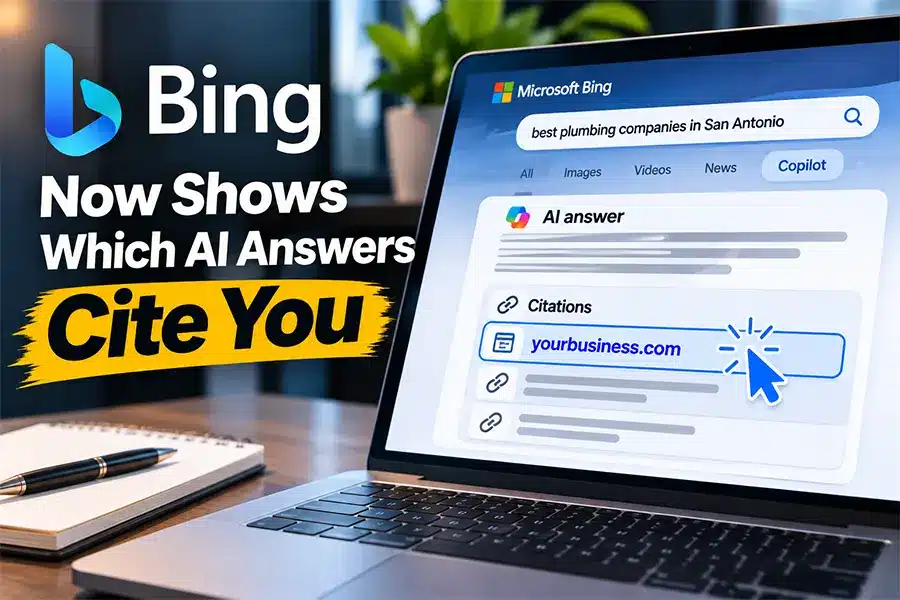
Bing Now Shows Which AI Answers Cite You
Bing Webmaster Tools now shows which AI answers cite your website and which questions your competitors win. Here are 6 steps San Antonio business owners can take this...