

Table of Contents
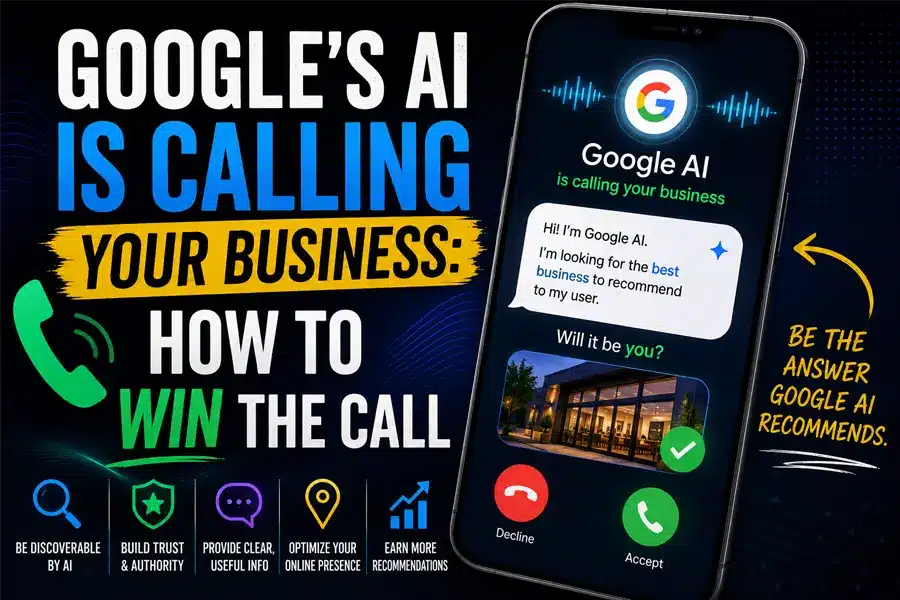
Google’s AI now phones local businesses on behalf of real customers — and nearly half of the businesses that pick up fail the very first question. Google’s “Ask for Me” feature is live across the United States, and it changes how new customers reach you. Instead of calling three plumbers, salons, or repair shops themselves, a customer taps a button in Google Search and lets an automated agent do the calling. Google AI phone calls arrive at your front desk sounding polite, asking about pricing and availability, and quietly deciding whether your business makes the customer’s shortlist. If your team doesn’t know how to answer, you lose the job before you ever knew you were competing for it.
What “Ask for Me” Actually Does
Here’s the scenario. A homeowner searches “plumber near me” and taps Google’s option to have AI check pricing for them. Google’s agent then calls the top businesses in the local map pack — typically the top three results — and asks a few direct questions: What are your rates? What’s your service area? Do you have availability? The agent opens every call by identifying itself as an automated system from Google calling on behalf of a real customer.
When the calls are done, the customer gets a tidy summary comparing every business that answered. Google has also rolled the same idea into shopping: searchers looking for products “near me” can have Google call local retailers about stock and discounts, then receive the results by text or email.
The feature launched for home services, beauty, and pet care, and it is expanding into more service categories through this year. If your business takes bookings or quotes by phone, assume Google AI phone calls are coming to you — or already have.
The Numbers Every Business Owner Should See
Call-tracking firm Invoca measured these AI-initiated calls over several months, and the trend line is steep. Call volumes surged more than 300% in a single month, and for plumbing companies specifically, volume jumped over 650% month-over-month. This is not a lab experiment — it’s a channel that’s already ringing phones.
Two findings should worry you more than the growth itself:
- 48% of businesses that answered failed to provide pricing information. When an AI is comparing you against competitors who did give a range, “we’d have to see the job first” reads as a dead end — and you drop off the shortlist.
- 26% of calls went completely unanswered. Roughly one in four businesses never even got the chance to compete. Google groups unreachable businesses into a “couldn’t be reached” bucket in the summary the customer sees — a soft disqualification in plain view.
Put simply: answering Google AI phone calls well is now a ranking factor for your revenue, even if it never appears in any SEO dashboard.
Old Phone Lead vs. AI-Mediated Call: What Changed
The traditional inbound call rewarded rapport. You could ask questions, build trust, and steer the conversation toward a booking. Google AI phone calls strip all of that away — you’re being scored on clarity and completeness, side by side with every competitor the agent called. Here’s how the two compare:
| Traditional Customer Call | Google AI Phone Call | |
|---|---|---|
| Who’s on the line | The actual customer | Google’s automated agent, calling for the customer |
| What wins the job | Rapport, trust, guiding the conversation | Clear answers: a price range, availability, next step |
| What loses the job | Poor service or follow-up | No answer, vague pricing, “it depends” with no range |
| How you’re judged | One conversation at a time | Side-by-side comparison against every business called |
| Who gets called | Anyone the customer finds | Top local map pack results — usually the top three |
How to Win the Call: Train Your Team This Week
The fix is not complicated, but it does require preparation before the phone rings. Every person who answers your phone — owner, office manager, or the newest hire — should be able to handle Google AI phone calls in under 30 seconds. Here’s the sequence:
HOW TO WIN A GOOGLE AI PHONE CALL
The 30-second framework that keeps you on the customer’s shortlist
ANSWER THE CALL
26% of AI calls go unanswered. Treat it as a lead, never spam.
GIVE A PRICE RANGE
“Typical jobs run $X–$Y.” A range beats silence — 48% fail here.
STATE AVAILABILITY
“We usually have same-day or next-day openings.” Specific and short.
OFFER A NEXT STEP
“The customer can book online or call us back to schedule.”
Write those four lines down, put them next to every phone, and rehearse them once at your next team meeting. You don’t need exact quotes — you need ranges. “A typical drain clearing runs between $150 and $300 depending on what we find” is enough to land you in the comparison summary. On Google AI phone calls, vague answers are treated the same as no answer.
Your Local Rankings Just Got More Valuable
Google’s agent doesn’t call everyone — it calls the businesses that rank in the local map pack. That means your Google Business Profile is now the gatekeeper for a whole new lead channel. If you’re not in the top three for the searches that matter, Google AI phone calls will ring your competitors instead of you.
Three things to check this month:
- Your phone number is correct everywhere. Your Google Business Profile, website, and directory listings should show the same number that a live human actually answers during business hours.
- Your categories and services are complete. The AI matches customer requests to businesses by what your profile says you do. Missing services mean missed calls.
- Your map pack position is trending up, not down. Reviews, photos, posts, and consistent citations still drive local rankings — and local rankings now decide who gets these calls at all.
This is the same playbook that wins regular local SEO, but the stakes are higher: the map pack used to earn you a chance at a conversation. Now it earns you a spot on an automated call list that converts directly into booked jobs.
Frequently Asked Questions
How do I know it’s Google’s AI calling and not a spam robocall?
The agent announces itself at the start of the call as an automated system from Google calling on behalf of a customer. Unlike spam robocalls, it asks specific, relevant questions about your services, pricing, and availability. Train your team to stay on the line and answer — hanging up on Google AI phone calls is hanging up on a real customer’s request.
Can I opt out of these calls?
Yes — businesses can decline Google AI phone calls during a call or manage preferences through their Google Business Profile. But think hard before opting out: the customer still gets a comparison summary, just without you in it. Opting out doesn’t stop the shortlist; it only removes you from it.
What if my pricing really does depend on the job?
Give a range with the variable named: “Most water heater replacements run $1,200 to $2,500 depending on the unit size.” That answers the question, sets expectations, and keeps you in the running. Businesses that refuse to give any number are the 48% that disappear from the customer’s summary.
Ready to Win Every Call Google Sends Your Way?
FOG Digital Marketing helps businesses rank in the local map pack and turn AI-driven calls into booked jobs. Let’s make sure Google’s AI puts you on the shortlist — not your competitors.
Our Blog
Website Design Blogs

WordPress 7.1.3 Fixes 7 Holes: Update Your Site Now
WordPress 7.1.3 Fixes 7 Holes: Update Your Site Now October 20, 2026 Web Design Table of Contents WordPress 7.1.3 fixes seven security holes, and the WordPress team says...

Can an AI Website Builder Build My Business Site?
Can an AI Website Builder Build My Business Site? September 9, 2026 Web Design Table of Contents Yes, an AI website builder can produce a working business website...

Core Web Vitals: Why Slow Sites Are Losing Rankings
Core Web Vitals 2026: Why Slow Sites Are Losing Rankings July 7, 2026 Web Design Table of Contents If your website takes more than 2.5 seconds to show...
2 Responses