

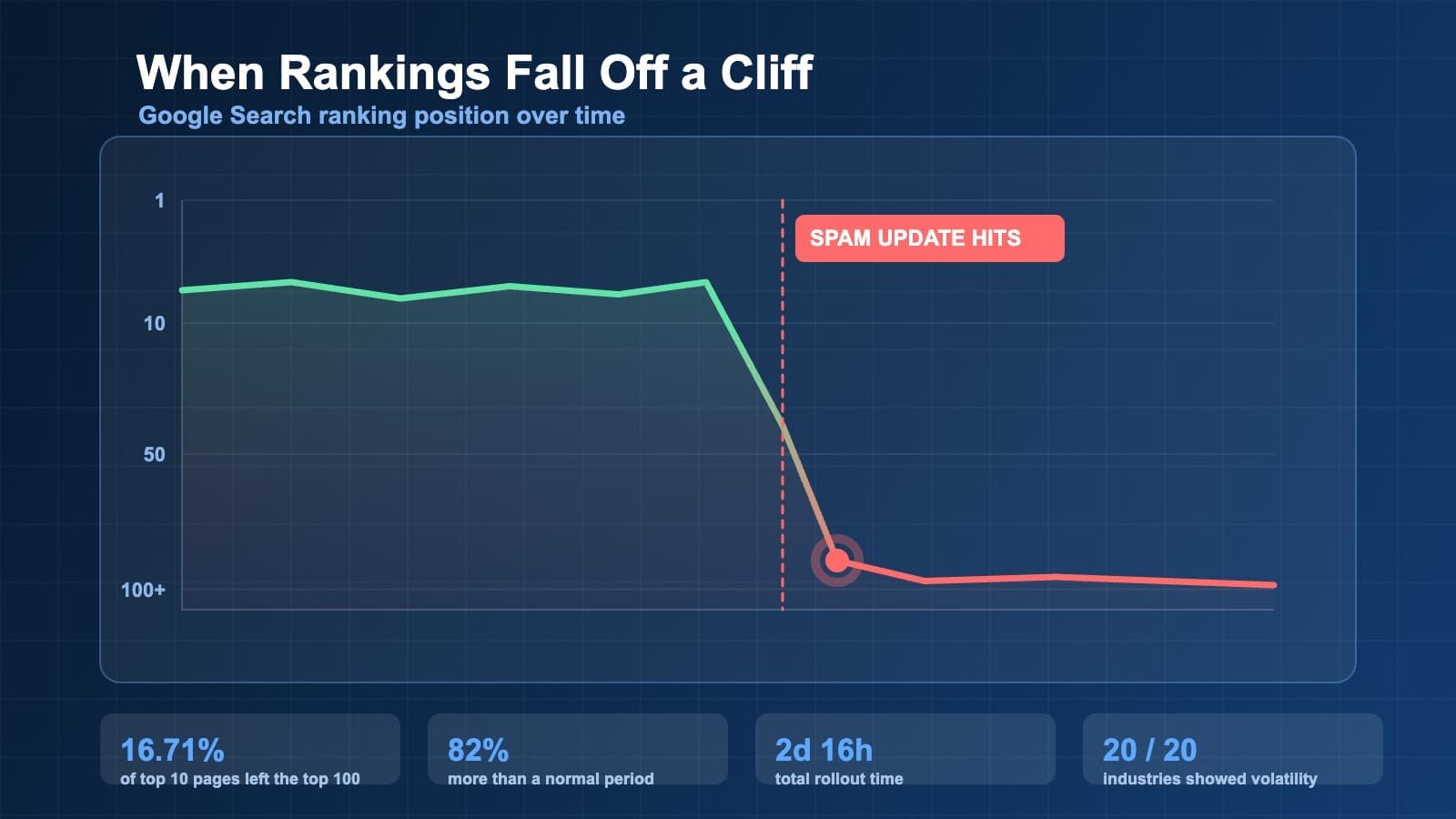
Google’s August spam update knocked 16.71 percent of top ten pages completely out of the top 100 results, nearly double the normal rate. It started rolling out on August 18 and finished 2 days and 16 hours later, according to Google’s own Search Status Dashboard. If your phone got quieter in the last two weeks and you cannot figure out why, this is the first place to look.
The important part for a business owner is that this Google spam update did not only hit obvious spam sites. Volatility from the Google spam update showed up across all 20 industries that were measured. Ordinary local businesses got caught in the churn, and most of them still do not know it happened.
Key Takeaways
- Google confirmed the August 2026 spam update began rolling out on August 18, 2026 and completed after 2 days and 16 hours, per Google’s Search Status Dashboard.
- SE Ranking found that 16.71 percent of URLs ranking in Google’s top 10 fell past position 100 during the update, compared to 9.2 percent in a normal five day period in July.
- That is an 82 percent increase in pages being wiped from the top 100, making a top ten page roughly 1.8 times more likely to vanish than during ordinary search churn.
- Ranking volatility hit all 20 industries tracked, ranging from 74.64 percent in real estate to 85.55 percent in fashion and beauty.
- SE Ranking also measured a 12 percent increase in pages jumping into the top 3 that had not previously ranked in the top 20, so this update created winners as well as losers.
- A Google spam update targets manipulative tactics rather than content quality, which means recovery usually requires removing something rather than writing more.
What Actually Happened in the Google Spam Update
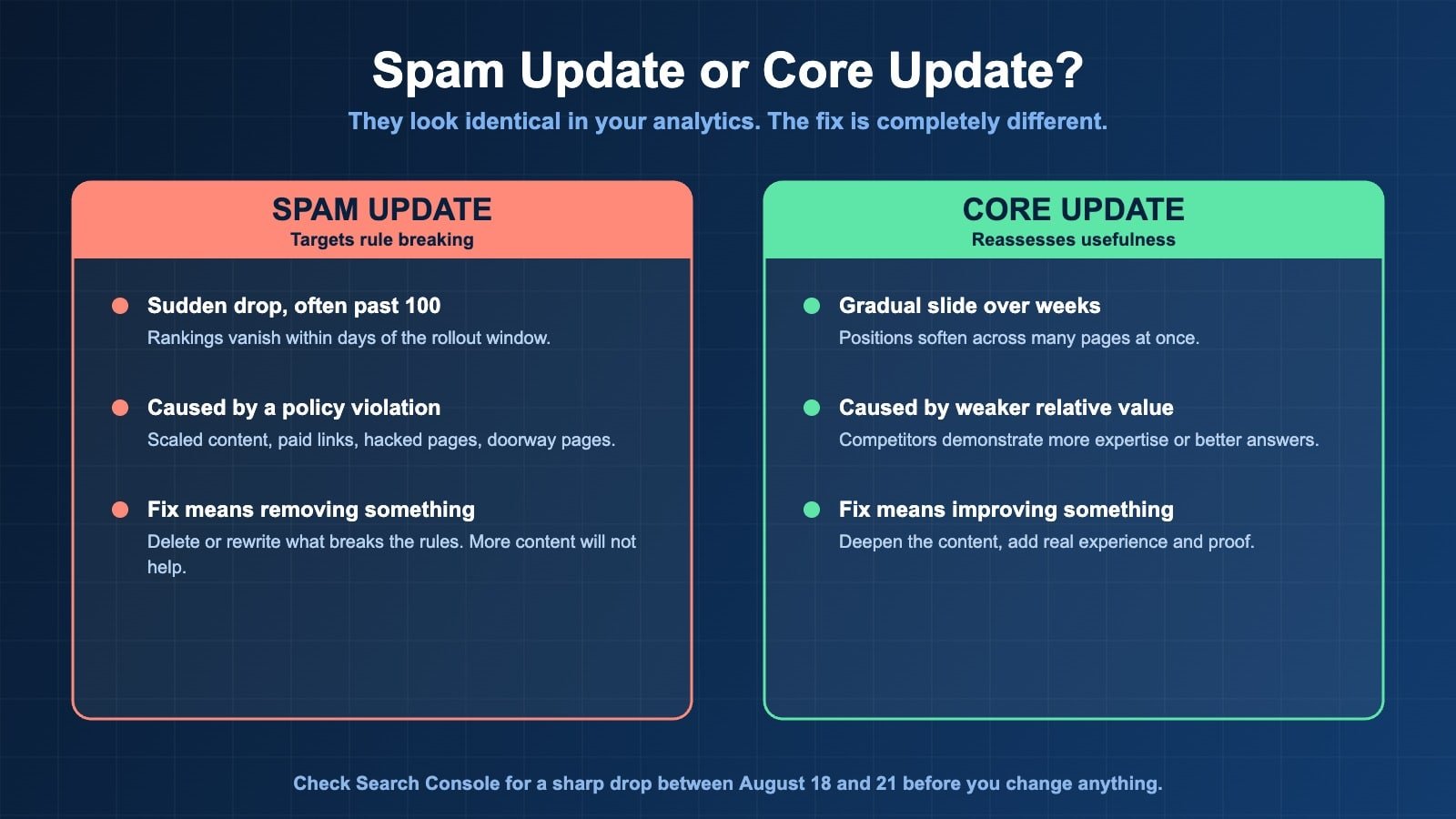
A Google spam update is one of two very different kinds of ranking change that business owners constantly confuse. A core update reassesses how useful and trustworthy your content is overall. A spam update is narrower. It improves Google’s automated systems, including its AI spam detection system called SpamBrain, at catching tactics that violate Google’s spam policies.
According to Google’s official Search Status Dashboard ranking history, the August 2026 spam update launched on August 18, 2026 and took 2 days and 16 hours to finish. That is fast. The August 2025 spam update took more than 26 days. A short rollout means the ranking swings landed suddenly rather than drifting in over a month, which is exactly why so many owners noticed a sharp drop with no warning.
Google explains its own definition on its Search Central documentation for spam updates. The distinction matters because the fix is completely different. If a core update hurt you, you improve your content. If a Google spam update hurt you, something on your site is being read as manipulation, and adding more content will not help.
Why This One Hit Harder Than Normal
The scale is what separates this Google spam update from the routine ones. Search Engine Land reported SE Ranking data on the August spam update’s ranking impact on August 27, 2026, and the numbers are worth understanding.
During the update, 16.71 percent of URLs that had been ranking in the top 10 dropped beyond position 100 for the same keyword. In a comparable five day stretch in July with no confirmed update, that figure was 9.2 percent. That is an 82 percent increase in pages being erased from the first hundred results, which is not a demotion. It is a disappearance.
Two things about that data should shape how you react. First, the volatility was broad rather than targeted. Every one of the 20 industries measured showed top ten volatility between 74.64 percent and 85.55 percent, with real estate lowest and fashion and beauty highest. Second, SE Ranking noted a 12 percent increase in pages reaching the top 3 that had not previously cracked the top 20. Somebody replaced the pages that fell. In a local market, that somebody is usually a direct competitor.
One honest caveat that most coverage skipped: SE Ranking did not run a URL level or domain level analysis, so the data does not prove which specific tactics were penalized. Anyone telling you they know exactly which tactics this Google spam update targeted is guessing.
Was It the Spam Update or Something Else
Before you blame the Google spam update and tear your site apart, confirm the timing actually matches. Open Google Search Console, set the date range to the last 3 months, and look at clicks and average position around August 18 through August 21, 2026. Here is how to read what you find.
| What You See | Likely Cause | Your Next Move |
|---|---|---|
| Sharp drop on Aug 18 to 21, position falls past 100 | Spam update | Audit for policy violations, then remove them |
| Gradual slide over several weeks | Content quality or a competitor improving | Rewrite thin pages, add real expertise |
| Impressions steady, clicks falling | AI answers absorbing the click | Optimize to be cited, not just ranked |
| Only map pack visibility dropped | Business Profile issue, not the spam update | Check your profile for edits or suspension |
| Message in Search Console Manual Actions | Human reviewer penalty, separate issue | Fix the cited issue, file reconsideration |
That last row matters. A Google spam update is algorithmic and there is no reconsideration request to file. A manual action is a human decision and it does have an appeal path. Check the Manual Actions report before assuming which one you are dealing with. If your rankings have been bouncing for months rather than dropping once, our breakdown of what to do during Google ranking volatility covers that pattern in more depth.
What To Check On Your Site This Week
These five checks target the tactics a Google spam update is built to catch. Work through them in order. At FOG Digital Marketing we run this exact sequence for San Antonio clients after every confirmed update.
The 5 Step Spam Update Recovery Audit
Confirm the date lines up
Search Console, last 3 months, look at August 18 through 21. No drop there means this is not your problem.
Audit pages you did not write
Bulk generated location pages and mass produced AI articles are the most common trigger for a local business.
Review every link you paid for
Directory packages, guest post bundles and any vendor promising links. Paid links that pass ranking value violate policy.
Scan for content you cannot see
Hacked pages and injected spam are common on older sites. Search Google for site:yourdomain.com and read every result.
Check who took your spot
Search your top keywords and study the pages now ranking. What they cover that you do not is your roadmap.
Step four catches more businesses than owners expect. A site running an outdated plugin can be serving spam pages to Google that never appear in your own admin. That is ordinary maintenance work, and it sits squarely inside technical SEO services rather than content strategy. Step two is where the Google spam update most often bites local companies, because a previous agency built out fifty near identical city pages and every one of them now reads as scaled content abuse.
What Google’s Spam Policies Actually Prohibit
Most owners have never read Google’s spam policies, which makes it hard to know whether a Google spam update should worry you. The policies name specific practices. These are the ones that realistically catch legitimate local businesses, usually because a vendor did them without explaining what they were.
- Scaled content abuse. Producing many pages primarily to game rankings rather than to help people. The volume is not the issue by itself. The issue is pages with no independent value. Fifty city pages that differ only by the town name is the textbook case, and it is the single most common reason a Google spam update hits a service business.
- Doorway pages. Pages built to rank for a location or variation that then funnel everyone to the same destination. If a visitor landing there would feel redirected rather than informed, Google treats it as a doorway.
- Link spam. Buying links, exchanging links at scale, or using directory and guest post packages where the link is the product. Google’s policy is specific: links intended to manipulate rankings violate it, whether you bought them or a vendor did.
- Cloaking and sneaky redirects. Showing Google something different from what a visitor sees. This is often not deliberate. Hacked sites and some aggressive optimization plugins do it without the owner knowing.
- Hidden text and keyword stuffing. Text set to match the background colour, positioned offscreen, or lists of city names crammed into a footer. This is an old tactic that still appears in older templates.
- Expired domain abuse and site reputation abuse. Buying an aged domain for its history, or renting out sections of your site to third party content. Both got explicit policy attention and both are now enforced.
Read that list against your own site honestly. If a previous agency generated location pages in bulk, or a lead generation vendor placed links for you, you have a plausible cause. If none of it applies, a Google spam update is probably not what hit you, and you should be looking at content quality or a competitor instead.
One practical note. You do not need to guess at intent. Google evaluates the result, not the motive. Pages built with good intentions that still produce no independent value are treated the same as pages built to manipulate, which is why “we did not mean to spam” is not a defence worth building your recovery around.
How Long Recovery Actually Takes
Set expectations honestly about Google spam update recovery, because this is where businesses waste money. Google has stated that recovery from a spam update requires fixing the underlying violation, and that even after you fix it, improvement typically appears when the spam systems next reassess your site. That is not a next week outcome.
Practically, plan on removing or rewriting the offending pages, then waiting for a recrawl and a subsequent system refresh. Businesses that clean up thoroughly and immediately tend to move sooner than those who delete two pages and hope. If your traffic was already sliding before August because AI answers were intercepting your clicks, then the Google spam update was only part of the story, and our guide to fixing zero click search losses plus our breakdown of how Google AI search changed the way customers find you explain the rest of it.
Meanwhile, do not stop everything else. The businesses that recover fastest keep publishing genuinely useful pages while the cleanup happens, which is the ordinary work of a San Antonio SEO company, and they make sure they are still discoverable in AI answers through AI search optimization while their traditional rankings rebuild.
Common Mistakes We See After Every Update
- Deleting pages at random after a Google spam update. Removing content that was never the problem loses you rankings you still had. Diagnose before you cut.
- Filing a reconsideration request. There is no appeal for an algorithmic update. That form only applies to manual actions, and submitting it otherwise accomplishes nothing.
- Publishing more content to compensate. If the Google spam update flagged scaled content, adding volume makes the signal stronger, not weaker.
- Assuming it was the update. Plenty of August traffic drops were seasonal, or a broken tracking tag, or a competitor finally fixing their site. Verify the date first.
- Hiring whoever caused it to fix it. If a vendor built the mass produced pages or bought the links, they are unlikely to identify their own work as the cause.
Frequently Asked Questions
How do I know if the Google spam update hit my website?
Open Google Search Console, set the date range to the last 3 months, and check whether clicks and average position fell sharply between August 18 and August 21, 2026. A sudden drop in that exact window points to the spam update. A gradual decline over weeks points to something else, most often content quality or a competitor improving.What is the difference between a spam update and a core update?
A Google spam update improves Google’s ability to detect tactics that violate its spam policies, while a core update reassesses the overall helpfulness and reliability of content. The practical difference is the fix. Spam update recovery means removing a violation. Core update recovery means genuinely improving your content.Can I appeal or ask Google to review my site after a spam update?
No. A Google spam update is algorithmic, and algorithmic updates have no appeal process and no reconsideration request. The reconsideration form applies only to manual actions, which appear as a message in the Manual Actions report inside Search Console. Check that report first to confirm which situation you are in.My rankings dropped but my Google Business Profile still shows up. What does that mean?
That pattern usually means your website was affected while your local listing was not, since the map pack is ranked by a different set of signals. It also means your profile is currently carrying your lead flow, so protect it and keep it accurate while you repair the website side.How long until my rankings come back?
Recovery depends on fixing the actual violation and then waiting for Google’s spam systems to reassess your site, which is a matter of weeks or longer rather than days. Businesses that clean up completely and quickly tend to recover sooner than those making partial changes over several months.
A Google spam update this disruptive creates openings as well as damage. Twelve percent more pages broke into the top 3 from outside the top 20, which means the businesses that audited honestly and fixed things quickly took positions that had been locked up for years. If your traffic changed in the back half of August, find out why now, while your competitors are still assuming it will fix itself.

WordPress 7.1.3 Fixes 7 Holes: Update Your Site Now
WordPress 7.1.3 Fixes 7 Holes: Update Your Site Now October 20, 2026 Web Design Table of Contents WordPress 7.1.3 fixes seven security holes, and the WordPress team says...

Can an AI Website Builder Build My Business Site?
Can an AI Website Builder Build My Business Site? September 9, 2026 Web Design Table of Contents Yes, an AI website builder can produce a working business website...

Core Web Vitals: Why Slow Sites Are Losing Rankings
Core Web Vitals 2026: Why Slow Sites Are Losing Rankings July 7, 2026 Web Design Table of Contents If your website takes more than 2.5 seconds to show...