

Table of Contents
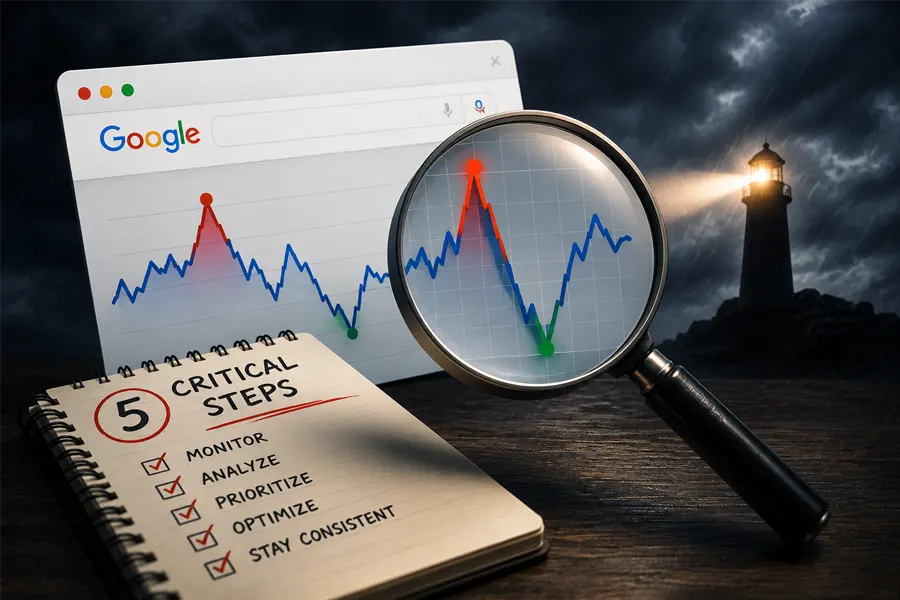
If your Google rankings jumped around for no clear reason this month, you are not imagining it, and you probably did not do anything wrong. Google search results have been unusually choppy through July, with three separate waves of Google ranking volatility hitting websites and Google Business Profiles of every size, and Google has not confirmed a single one of them. If you run a local business and your calls or website visits swung without warning, here is what actually happened, how to tell a real problem from normal noise, and exactly what to do about it this week.
What Is Google Ranking Volatility, and Why Is It Happening So Often
Google ranking volatility is a noticeable, often temporary shift in where your website or Google Business Profile shows up in search results, without Google announcing an official update. Independent tracking tools such as SEMrush Sensor, Mozcast, and Sistrix measure these shifts daily on a scale of roughly 0 to 10. Anything above 7 or 8 signals unusually high movement across a large number of search results at once.
This month alone, tracking tools recorded three distinct spikes in ranking movement: one that built through the first two weeks of July, another over the weekend of the 18th and 19th, and a third that hit hard on July 23rd and 24th. Business owners in online forums reported traffic swings of 15 to 25 percent in a single day, with some sites seeing drops as steep as 60 to 70 percent. None of these waves has been confirmed by Google, and none appears on Google’s official Search Status Dashboard.
That gap between what the trackers are showing and what Google is willing to confirm is exactly why Google ranking volatility causes so much anxiety for business owners. You can see the effect on your bottom line, but you get no explanation from the source.
How to Tell a Real Algorithm Update From Normal Noise
Not every dip in traffic is a sign of a broader algorithm shift, and not every spike is a confirmed update. Before you touch your website, figure out which one you are actually looking at. The table below breaks down the difference.
| Signal | Confirmed Core Update | Unconfirmed Ranking Volatility |
|---|---|---|
| Google Search Status Dashboard | Named and listed with start and end dates | Not listed, not named |
| Typical duration | 1 to 3 weeks, publicly announced rollout | Hours to a few days, then fades |
| Tracker agreement | Nearly all trackers spike together and stay elevated | Trackers spike together, then diverge quickly |
| Search Console pattern | Broad, sustained position changes across many keywords | Choppy, keyword by keyword, often reverses within days |
| Recommended action | Review content quality, E-E-A-T, and technical health | Monitor closely, avoid reactive changes |
If what you are seeing matches the right hand column, the safest move is patience, not panic.
5 Moves to Make During a Google Ranking Volatility Window
You cannot control an unconfirmed swing in the algorithm, but you can control how you respond to it. Work through these five steps in order, whether this is happening to you right now or the next time it hits.
Check Search Console
Compare the last 28 days to the prior 28
Cross Check Trackers
Confirm with 2 or more tools
Watch Revenue, Not Rank
Track calls and form fills
Hold Off 2 to 3 Weeks
No reactive site changes
Document the Baseline
Screenshot data and dates
Here is what each step actually looks like in practice. Start in Google Search Console, not a third party dashboard. Open Performance, then Search Results, and compare the last 28 days to the prior 28. Real position changes show up here days before they show up in your call volume or form submissions. Next, cross check at least two independent trackers. A single tool spiking could just be a bug in that tool, while multiple tools agreeing is a much stronger signal that something real is moving.
From there, separate rankings from revenue. A keyword dropping three spots rarely matters if your calls, form fills, and foot traffic have not moved, so watch the business outcome, not the vanity metric. Then hold off on reactive site changes for at least two to three weeks. Rewriting titles, deleting pages, or overhauling your Google Business Profile in a panic often does more damage than the swing itself, especially since many of these movements reverse on their own. Finally, document what you saw. Screenshot your rankings, your Search Console data, and the date, so if this becomes a confirmed update later, or happens again, you have a real baseline instead of a guess.
What Not to Do When Rankings Swing
A little discipline during a Google ranking volatility window saves you from making things worse. A few rules worth following every time:
- Do not rewrite your whole website overnight because one keyword moved a few spots.
- Do not fire your SEO or web design partner over a swing that reverses within a week.
- Do not pause ad campaigns you rely on to cover the gap. Ranking volatility affects organic results, not paid placements.
- Do not ignore it either. If a drop persists past three weeks and shows up in both Search Console and your actual leads, that is worth a real investigation.
Building Ranking Stability So the Next Wave Does Not Wreck You
Google ranking volatility is not going away. Google now runs some form of algorithm tuning almost continuously, and only a handful of these movements get an official name each year. The businesses that ride out these waves calmly tend to share a few habits: a complete, accurate Google Business Profile, a consistent business name, address, and phone number across every directory, a steady stream of recent reviews, and website content that clearly answers what customers are searching for instead of chasing keywords.
None of that prevents these swings from happening. It does mean that when the noise settles, you land back where you belong instead of losing ground for good. If you want a second set of eyes on whether a recent swing in your rankings is normal or something worth fixing, that is exactly the kind of question a quick audit can answer.
Frequently Asked Questions
Why do my Google rankings keep changing without an official update?
Google runs algorithm adjustments almost continuously, and it only confirms a small fraction of them publicly. Independent tracking tools pick up Google ranking volatility well before, and sometimes instead of, any official announcement from Google itself.
How long does a typical Google ranking volatility window last?
Most unconfirmed volatility settles within one to three weeks. If a swing in your rankings has not stabilized after three weeks and matches a real change in your calls or leads, that is when a closer technical review is worth the time.
Should I change my website every time I see a ranking drop?
No. Reactive changes made during a Google ranking volatility window can do more harm than the volatility itself. Confirm the drop with Search Console data over at least two weeks before making any structural changes to your site.

Not Sure If That Ranking Swing Is Normal?
FOG Digital Marketing tracks your rankings, reviews, and Search Console data year round, so you know the difference between normal noise and a real problem before it costs you leads.
Our Blog
Website Design Blogs

Can an AI Website Builder Build My Business Site?
Can an AI Website Builder Build My Business Site? September 9, 2026 Web Design Table of Contents Yes, an AI website builder can produce a working business website...

Core Web Vitals 2026: Why Slow Sites Are Losing Rankings
Core Web Vitals 2026: Why Slow Sites Are Losing Rankings July 7, 2026 Web Design Table of Contents If your website takes more than 2.5 seconds to show...

ADA Website Compliance: Critical 2026 Alert for Owners
ADA Website Compliance: Critical 2026 Alert for Owners July 6, 2026 Web Design Table of Contents If your website has a broken form field, low-contrast text, or an...
One Response