Key Takeaways
- Your reputation directly impacts leads—poor reviews or weak presence cost you real calls and jobs
- Strong reviews and ratings improve your Google rankings and increase click-through rates
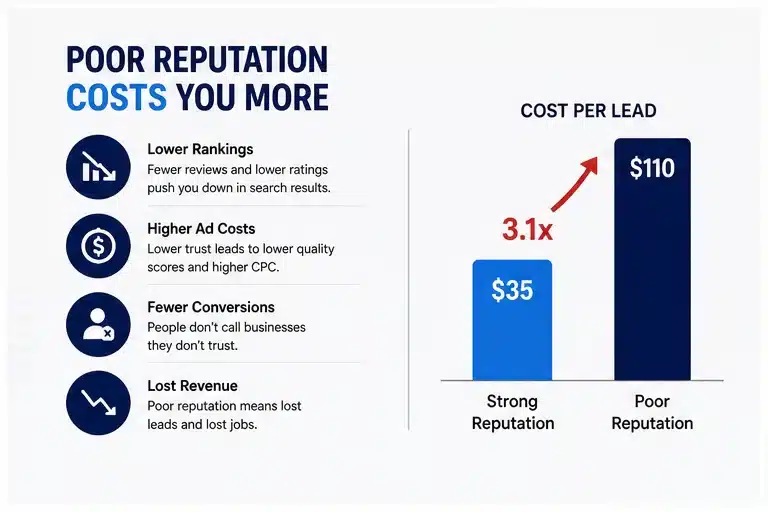
- Bad reputation lowers ad performance, increasing cost per lead and reducing conversions
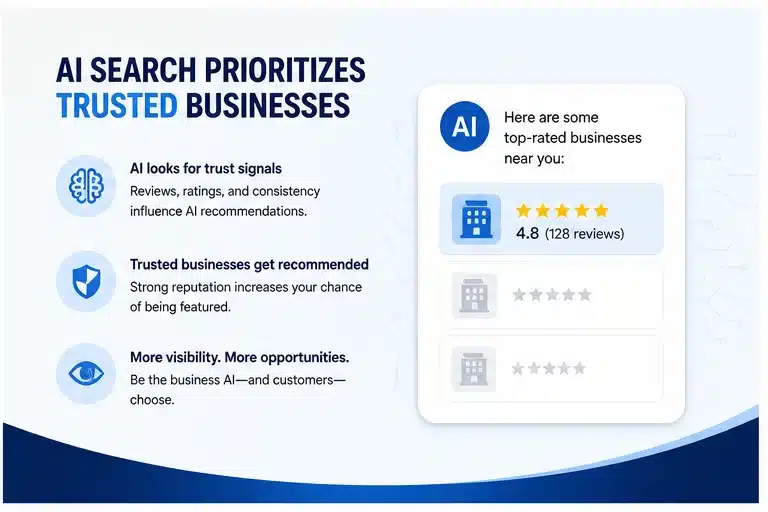
- AI search platforms like Google AI Overviews prioritize trusted, well-reviewed businesses
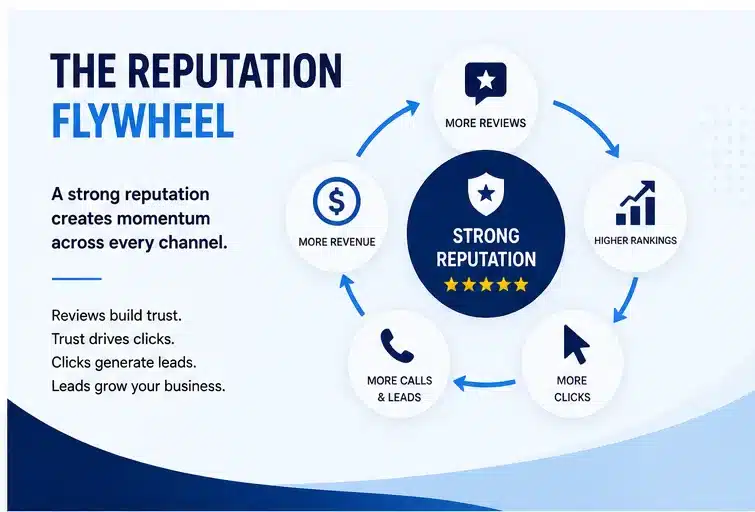
- Traffic alone doesn’t convert—trust signals (reviews, consistency, activity) are what turn visibility into customers
Introduction
Most business owners think of reviews as “nice to have.”
That’s outdated.
Today, your online reputation directly affects:
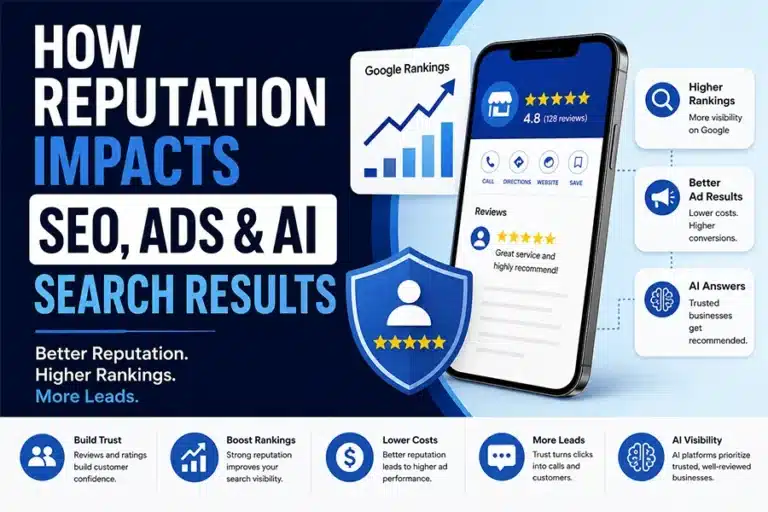
- whether you rank on Google
- how much you pay for ads
- whether AI platforms recommend your business
If your reputation is weak or inconsistent you’re not just losing credibility.
You’re losing calls, leads, and revenue.
This guide breaks down exactly how reputation influences SEO, paid ads, and AI search results—and what you need to fix to stay competitive.
Why Reputation Matters More Than Ever
Google is no longer just ranking websites.
It’s evaluating business credibility across multiple signals, including:
- reviews
- consistency across platforms
- user engagement
- brand mentions
At the same time, AI-driven search tools like Google AI Overviews and Microsoft Copilot are pulling business recommendations based on trust signals not just keywords.
👉 Translation:
If your reputation is weak, you won’t just rank lower, you may not appear at all.
How Reputation Impacts SEO Rankings
⭐ Reviews influence local rankings
Google’s local algorithm heavily considers:
- number of reviews
- rating quality
- recency
- keyword relevance inside reviews
Businesses with:
- consistent 4.5+ ratings
- frequent new reviews
👉 are far more likely to appear in the Map Pack
📍 Reputation affects click-through rate (CTR)
Even if you rank:
- 4.8⭐ with 200 reviews → gets clicks
- 3.9⭐ with 20 reviews → gets ignored
👉 Higher CTR = stronger ranking signals over time
🔗 Brand trust influences organic performance
Google evaluates:
- brand searches
- mentions across the web
- consistency of your business information
👉 A strong reputation reinforces topical authority
How Reputation Affects Paid Ads Performance
Most businesses overlook this completely.
💰 Google Ads uses trust signals
While not officially labeled “reputation,” your ads are impacted by:
- landing page experience
- expected CTR
- brand trust
👉 Better reputation = higher Quality Score
👉 Higher Quality Score = lower cost per click
📉 Poor reputation kills conversions
Even if your ad performs:
- users Google your business name
- see bad reviews
👉 they don’t call
📌 Simple reality:
You don’t lose money on ads because of targeting.
You lose money because of trust gaps.
How Reputation Impacts AI Search Results
This is where most businesses are falling behind.
AI search doesn’t work like traditional SEO.
Platforms like:
- Google AI Overviews
- Microsoft Copilot
👉 pull data from:
- Google Business Profiles
- reviews
- authoritative mentions
- structured content
🧠 AI prioritizes “safe recommendations”
AI systems are designed to recommend:
- trustworthy
- consistent
- well-reviewed businesses
If your reputation is:
- inconsistent
- low-rated
- inactive
👉 AI is less likely to surface your business
⚠️ This is the shift:
Old SEO:
“Who ranks #1?”
New AI-driven search:
“Who can we confidently recommend?”
The Reputation Signals That Actually Drive Results
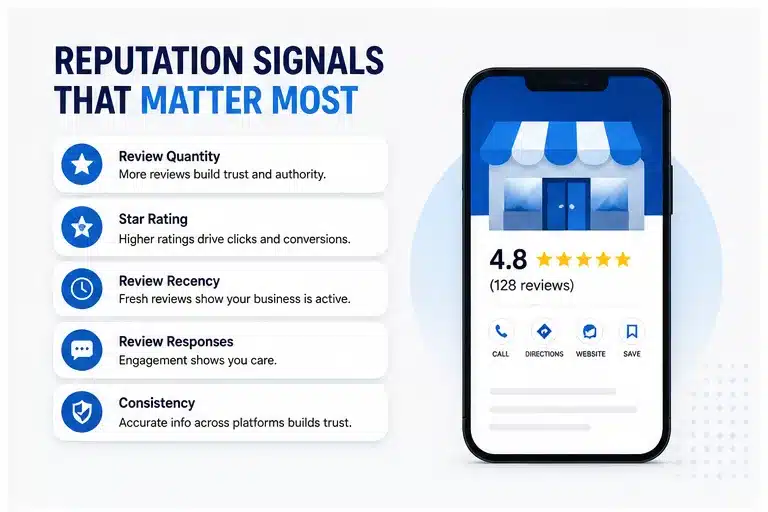
| Signal | Why It Matters |
|---|
| Review Volume | Shows consistent customer experience |
| Star Rating | Directly impacts clicks and trust |
| Review Recency | Indicates active, reliable business |
| Keyword Mentions | Helps Google understand your services |
| Response Rate | Signals engagement and professionalism |
| Consistency Across Platforms | Builds trust for both Google and AI |
What Most Businesses Get Wrong
❌ Only asking for reviews occasionally
❌ Ignoring negative reviews
❌ Having outdated or incomplete profiles
❌ Focusing only on rankings, not trust
❌ Running ads without fixing reputation
👉 These mistakes directly reduce leads even if traffic is high.
How to Improve Your Reputation (and Get More Leads)
✔ Step 1: Build a consistent review system
Ask every satisfied customer—systematically, not randomly.
✔ Step 2: Respond to every review
Shows activity, builds trust, improves engagement signals.
✔ Step 3: Optimize your Google Business Profile
Make sure your services, categories, and content are aligned.
✔ Step 4: Fix visibility gaps
Ensure your business appears consistently across platforms.
✔ Step 5: Align your website with your reputation
Your site should reinforce the same trust signals users see elsewhere.
When Reputation Becomes Your Competitive Advantage
Most businesses treat reputation as an afterthought.
But the ones that win:
- actively manage reviews
- monitor visibility
- align SEO + ads + reputation
👉 That’s how they dominate both Google and AI-driven search results.
Conclusion
If your business isn’t getting the calls it should, the issue isn’t always traffic.
Often, it’s trust.
Your reputation is now a ranking factor, a conversion factor, and an AI recommendation factor—all at the same time.
Fixing it doesn’t just improve your image.
👉 It directly increases your leads.