

Table of Contents
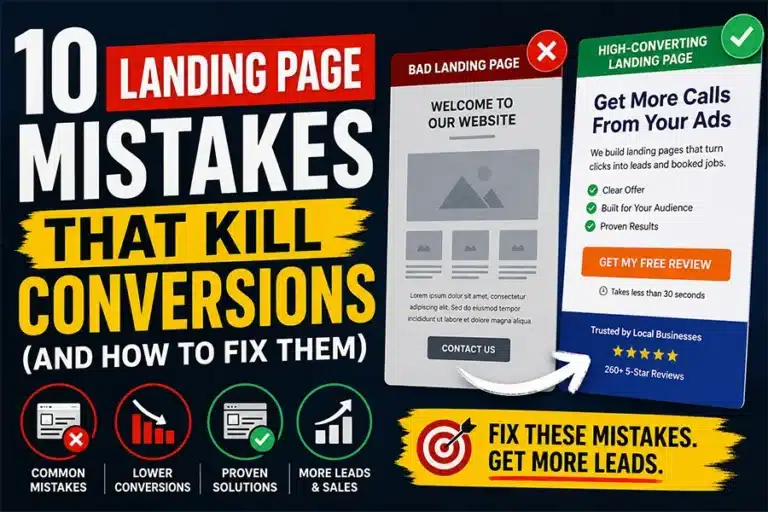
Most paid ads that underperform are not bad ads. They send good clicks to a page that loses them. The landing page mistakes that waste the most budget are simple: the click lands on a homepage instead of a page built for that search, the headline does not match the ad, the page is slow on a phone, and the form or phone number is hard to find. Google Ads scores this directly. Landing page experience is one of the three parts of every keyword's Quality Score.
Last updated October 23, 2026. Reading time about 10 minutes.
Key takeaways
- Google Ads names landing page experience as one of three Quality Score components, defined as how relevant and useful the page is to people who click your ad.
- Google's own description of landing page experience covers useful and relevant information, ease of navigation, the number of links on the page, and what the ad led people to expect.
- WordStream and LocaliQ put the median Google Ads conversion rate at 8.18 percent and the median cost per lead at $66.69 across 13,474 US search campaigns.
- In a Deloitte study commissioned by Google, a 0.1 second mobile speed gain was linked to 21.6 percent more lead generation visitors moving from the first form step to submission. That is a funnel step, not total conversions.
- Since October 12, 2026, Google Ads can automatically pull promotions from your website into your ads, so stale offers on your pages now leak into paid search.
- AI Max final URL expansion lets Google choose which page on your site receives a click, which makes every page a potential landing page.
Why do landing page mistakes cost more than bad ads?
Because the click is already paid for. By the time someone reaches your page, the ad has done its job and you have spent the money. Everything that happens next is the landing page's job, and landing page mistakes are where most of that spend quietly disappears.
Google treats it the same way. In the Google Ads Help Center, Quality Score is built from three parts: expected clickthrough rate, ad relevance, and landing page experience, which Google describes as how relevant and useful your landing page is to people who click your ad. Google's Search Ads 360 documentation is more specific, listing the usefulness and relevance of the information, ease of navigation, the number of links on the page, and the expectations users have from the ad they clicked.
That last point is the one most service providers miss. The ad makes a promise. The page either keeps it in the first screen or the visitor leaves. When Google updated its search ads system in early 2025, it said landing pages must be both relevant and easy to navigate, and that ads leading to misleading pages would be shown less, as reported by Search Engine Journal on February 5, 2025.
If you have been weighing paid ads against organic search, our breakdown of what SEO and paid ads really cost per lead shows why conversion rate is the number that decides which one pays off.
What does a normal landing page conversion rate look like?
Here is the most recent large benchmark for search ads, from the WordStream and LocaliQ 2026 Google Ads Benchmarks, which cover 13,474 US search campaigns between April 1, 2025 and March 31, 2026. Their averages are medians, so a few unusual accounts do not skew them.
median conversion rate across all industries
WordStream and LocaliQ, 2026 benchmarksmedian cost per lead across all industries
WordStream and LocaliQ, 2026 benchmarksmore visitors moving from the first form step to submission after a 0.1 second mobile speed gain
Deloitte and 55 for Google, Milliseconds Make Millions| Industry | Avg CPC | Conversion rate | Cost per lead |
|---|---|---|---|
| All industries | $5.42 | 8.18 percent | $66.69 |
| Home and home improvement | $8.33 | 8.05 percent | $90.92 |
| Attorneys and legal services | $9.87 | 5.55 percent | $131.63 |
| Dentists and dental services | $8.00 | 10.67 percent | $72.97 |
| Automotive repair and service | $4.35 | 15.51 percent | $29.96 |
Source: WordStream and LocaliQ, 2026 Google Ads Benchmarks, page updated September 16, 2026. Medians.
Read the table this way. At a $90.92 cost per lead, a home services company spending $3,000 a month gets roughly 33 leads. If fixing the page lifts the conversion rate by a quarter, the same budget buys about 41. That math is why a landing page audit usually pays back before any change to bids or keywords.
What are the 10 landing page mistakes that kill conversions?
These are the landing page mistakes we find most often when we audit service provider ad accounts. Each comes with the fix and the check you can run yourself.
1. Sending ad clicks to the homepage
A homepage talks to everyone, so it matches no single search well. Someone who searched for emergency AC repair lands on a page about your company history, three service categories and a blog. Fix: build one page per offer, with the service and city from the ad in the headline. Check: click your own ad and see whether the first screen answers the search.
2. A headline that does not match the ad
Google explicitly weighs the expectations users have from the ad they clicked. If the ad says "Same Day Water Heater Repair" and the page says "Welcome to Smith Plumbing", the promise breaks. Fix: repeat the ad's main phrase in the headline, word for word where it reads naturally.
3. A slow page on mobile
Google's Core Web Vitals targets are a Largest Contentful Paint of 2.5 seconds or less, Interaction to Next Paint of 200 milliseconds or less, and Cumulative Layout Shift of 0.1 or less, at the 75th percentile of real visits. Fix: compress the hero image, remove sliders and heavy scripts, and lazy load anything below the first screen. Check: run the page through PageSpeed Insights on mobile. Our guide to responsive web design covers the mobile checks in detail.
4. Too many ways to leave
Google's landing page experience guidance mentions the number of links on the page. A full site menu, footer links and social icons are all exits. Fix: remove the main navigation from paid landing pages and keep only the form, the phone number and the proof.
5. A form that is long, hidden or both
If the form sits below three screens of copy, or asks for a budget, a project timeline and a company size before anything else, most people will not finish it. Fix: place a short form in the first screen. Name, phone, email and one question about the job is enough to call someone back.
6. No tap to call phone number
Service buyers with an urgent problem want to call, not type. Fix: put a clickable phone number at the top and in a sticky bar on mobile, and track calls as conversions so you can see which page produces them.
7. No proof on the page
A visitor who has never heard of you needs a reason to trust you in seconds. Fix: show real reviews with names, license or certification numbers where your trade has them, photos of your own team and work, and a recognizable result. Avoid stock photos of people in hard hats who do not work for you.
8. A weak or vague offer
"Contact us for a free consultation" is the offer every competitor already makes. Fix: offer something specific that matches the search, such as a same day inspection, a written estimate within 24 hours, or a published starting price.
9. Stale promotions anywhere on your site
Search Engine Land reported on October 2, 2026 that Google Ads would begin automatically pulling deals from advertisers' websites into promotion assets for Search and Performance Max campaigns starting October 12, with advertisers opted in by default. An expired coupon on an old page can now appear in your ads. Fix: remove expired offers, or turn off automated promotions in the account level automated asset settings.
10. Tracking that does not work
If a form submission or call is not recorded as a conversion, Google's bidding optimizes toward the wrong thing and you cannot tell which page works. Fix: submit a test lead after every page change and confirm it appears in Google Ads and arrives in your inbox.
How do the fixes map to what they improve?
| Mistake | Fix | What it affects |
|---|---|---|
| Homepage as landing page | One page per offer, service and city in the headline | Landing page experience, conversion rate |
| Headline mismatch | Repeat the ad's main phrase | Landing page experience, bounce |
| Slow mobile page | Meet LCP 2.5s, INP 200ms, CLS 0.1 | Form completion, conversion rate |
| Too many links | Remove site navigation | Landing page experience, focus |
| Long or hidden form | Short form in the first screen | Conversion rate |
| No tap to call | Clickable number plus sticky mobile bar | Calls, conversion rate |
| No proof | Real reviews, licenses, own photos | Trust, conversion rate |
| Vague offer | Specific, search matched offer | Clickthrough and conversion rate |
| Stale promotions | Remove old offers or opt out | Ad accuracy, trust |
| Broken tracking | Test lead after every change | Smart bidding, cost per lead |
Quality Score components per Google Ads Help. Core Web Vitals thresholds per web.dev.
How does AI Max change which page gets the click?
Google's AI Max for Search campaigns include final URL expansion, which lets Google send a click to whichever page on your site it predicts will perform best, not only the URL you entered. Google announced on its Ads and Commerce blog on April 15, 2026, updated June 11, that campaigns using automatically created assets and campaign level broad match would begin upgrading to AI Max in September 2026, with the Dynamic Search Ads auto upgrade moved to February 2027.
The practical consequence is that a thin blog post or an outdated service page can now receive paid traffic. Either make sure your key service pages are ready to convert, or use the URL controls to keep paid clicks on the pages you built for them. We walk through the settings in our AI Max upgrade checklist.
How do you audit your landing page in 30 minutes?
Run these five checks in order. Most landing page mistakes show up in the first two.
Run the match test
Search your main keyword on your phone, click your own ad, and read only the first screen of the page. Does it say the same thing the ad promised?
You know whether the page keeps the ad’s promise.
Test mobile speed
Run the page through PageSpeed Insights on mobile and compare LCP, INP and CLS with the Core Web Vitals targets.
A list of the slowest elements to fix first.
Count the exits
Count every link that leads away from the form: menu items, footer links, social icons, blog links.
A shorter page with one clear next step.
Try to contact yourself
Tap the phone number and fill in the form on your phone. Time how long it takes and note every field you would skip.
A form and call path that work on a small screen.
Confirm the conversion
Check that your test lead appears as a conversion in Google Ads and that the notification email arrives.
Data you can trust when you change anything else.
What separates pages that convert from pages that leak?
Pages that leak budget
- Full site menu and footer on the paid page
- Generic headline such as "Welcome" or the company name
- Form below the fold with eight fields
- Stock photos and no reviews
- Same page for every ad group
Pages that convert
- No navigation, one offer, one form
- Headline that repeats the ad and names the city
- Short form and phone number in the first screen
- Named reviews, licenses and real job photos
- One page per service or offer
If your pages look more like the left column, our conversion rate optimization work starts exactly here, and our web design team builds dedicated pages for paid traffic.
Best practices and pro tips
- Change one thing at a time. If you rewrite the headline, shorten the form and swap the photos in the same week, you will not know which change worked.
- Write for the search, not the brand. The visitor typed a problem. Your headline should name that problem and the outcome.
- Keep paid pages out of organic search. Dedicated ad pages often repeat content from service pages. Set them to noindex so they do not compete with the pages you want to rank.
- Check the page every time the ad changes. Most headline mismatches happen when someone edits the ad and nobody updates the page.
- Do not trust a guarantee. No page design guarantees a conversion rate. Measure against your own baseline and your industry median.
Frequently asked questions about landing page mistakes
What are the most common landing page mistakes?
The most common landing page mistakes are sending ad clicks to the homepage, a headline that does not match the ad, a slow mobile page, too many exit links, a long or hidden form, and no visible proof such as reviews or licenses. Each one costs you leads you already paid for.
Does my landing page affect my Google Ads Quality Score?
Yes. Google Ads lists landing page experience as one of the three Quality Score components, alongside expected clickthrough rate and ad relevance. Google describes it as how relevant and useful your landing page is to people who click your ad.
Should I send Google Ads traffic to my homepage?
Usually not. A homepage serves every visitor at once, so it rarely matches the specific search that triggered the ad. A dedicated page with one offer, one form and the same wording as the ad gives the visitor a single clear next step.
How fast should a landing page load?
Aim to meet Google's Core Web Vitals: Largest Contentful Paint of 2.5 seconds or less, Interaction to Next Paint of 200 milliseconds or less, and Cumulative Layout Shift of 0.1 or less, measured at the 75th percentile of real visits. Test the mobile version first, since that is where most problems show up.
Does page speed really change how many leads I get?
It can. In the Milliseconds Make Millions study by Deloitte and 55, commissioned by Google, a 0.1 second improvement in mobile speed was associated with a 21.6 percent increase in lead generation visitors progressing from the first form step to submission, across 37 brand sites and over 30 million sessions. That figure measures one step of the form funnel, not overall lead volume.
What is a good conversion rate for a landing page?
There is no universal number. WordStream and LocaliQ report a median Google Ads conversion rate of 8.18 percent across 13,474 US search campaigns from April 2025 to March 2026, with home and home improvement at 8.05 percent and attorneys at 5.55 percent. Compare yourself to your own industry and to your own past results.
How many fields should a lead form have?
As few as you need to call the person back. For most service providers that means name, phone, email and one question about the job. Every extra field is one more reason to leave, so test removing fields before adding new ones.
Do I need a different landing page for every ad?
You need a page that matches each distinct offer or service, not every single ad. If one ad group sells water heater repair and another sells drain cleaning, each deserves a page that says exactly that in the headline.
How does AI Max affect my landing pages?
AI Max for Search campaigns can use final URL expansion, which lets Google send a click to whichever page on your site it predicts fits the search best. That means any page on your site can become a landing page, so either keep those pages ready for paid traffic or use the URL controls to exclude them.
How do I know which landing page mistake is costing me the most?
Start with tracking. Submit a test lead from your phone and confirm it shows up as a conversion in Google Ads and lands in your inbox. Then check speed, headline match and form length, in that order, because broken tracking hides every other problem.
The bottom line
Fixing landing page mistakes is the cheapest way to lower your cost per lead, because it makes the clicks you already buy work harder. Send each ad to a page built for it, match the headline to the ad, make it fast on a phone, cut the exits, keep the form short and the phone number visible, and confirm every lead is tracked. If you want a second set of eyes first, request a free website review and we will point out the landing page mistakes costing you the most.
About this article. Written and reviewed by the FOG Digital Marketing team in San Antonio, Texas, who build and audit landing pages for service providers running Google Ads. This guide to landing page mistakes uses public data only. Every figure above is taken from the named source and was checked on October 23, 2026.
Sources cited. Google Ads Help, About Quality Score; Google Search Ads 360 Help, Landing page experience; web.dev, Web Vitals; web.dev, Milliseconds Make Millions; WordStream, 2026 Google Ads Benchmarks; Search Engine Land, Google Ads will automatically pull promotions from advertisers' websites; Google Ads and Commerce blog, Dynamic Search Ads are upgrading to AI Max; Search Engine Journal, misleading landing pages now demoted.
Is your landing page losing the clicks you pay for?
We will review your ad landing pages for speed, message match, forms and tracking, then show you the fixes that lower your cost per lead.
Our Blog
Website Design Blogs

Agent-Ready Website: Prep Your Site for AI Shoppers
AI agents now browse, compare, and book on business websites for your customers. Here is what Cloudflare and Chrome just changed, and 5 fixes to make your site...

WordPress 7.2 Is Coming: 6 Steps to Prep Your Site
WordPress 7.2 ships December 8 and is ready for PHP 8.6, but your plugins may not be. Follow these 6 steps to back up, test, and update your...

DreamHost Breach: 5 Steps Every Website Owner Takes
The DreamHost breach exposed website login credentials. If you used DreamHost's File Manager since August, here are the 5 steps to secure your site, FTP, and email today.