

Table of Contents
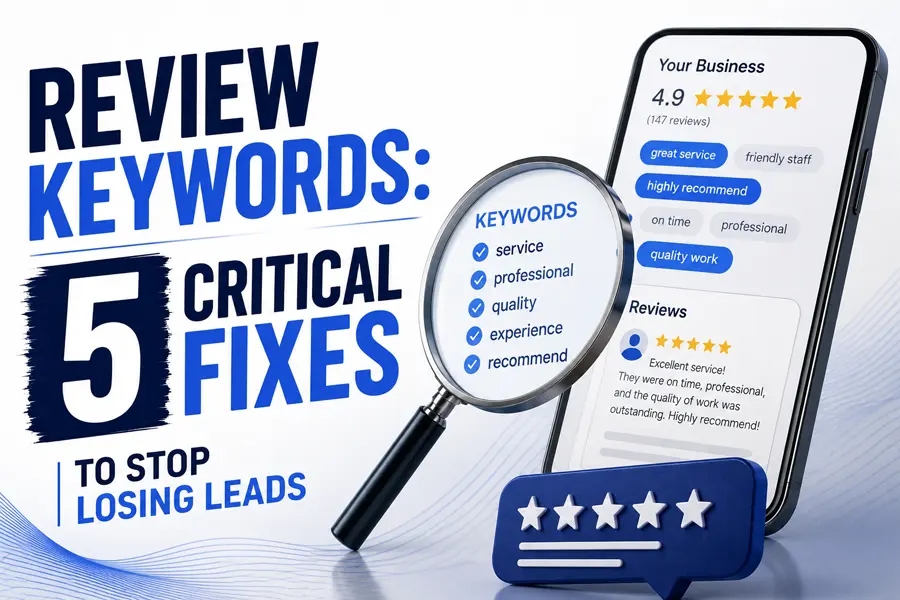
Your star rating won’t save you if nobody is typing the words AI search tools are actually scanning for. Google’s AI Overviews, ChatGPT, and Perplexity no longer just count how many five-star reviews you have. They read the sentences inside those reviews, pull out the services, products, and neighborhoods your customers mention, and use that language to decide who gets recommended. If your reviews all just say “great service, highly recommend,” you’re invisible to that process even with a perfect rating. This is where review keywords come in, and most business owners have never optimized for them on purpose.
Why Review Keywords Now Matter More Than Your Star Rating
For years, the advice was simple: get more reviews, keep your rating above 4.5 stars, and you’re set. That’s no longer the whole story. Review signals now make up a meaningful share of local ranking factors, and Google’s own local algorithm weighs relevance, distance, and prominence, with review content feeding directly into relevance. A business with 40 reviews that all say specific things, like “same-day AC repair” or “helped us pick tile for our kitchen remodel,” is giving Google and AI tools exact language to match against real searches. A business with 40 reviews that only say “great job, thanks!” is giving them nothing to work with.
This shift matters even more once you factor in how people search now. When someone asks ChatGPT “who does same-day AC repair near me” or types that same phrase into Google, the AI is pulling from public review text, Business Profile content, and on-page copy to build its answer. If review keywords describing your actual services never show up in that pool of language, you’re leaving the recommendation to a competitor whose customers happened to write more specific reviews.
What AI Search Tools Actually Do With the Words in Your Reviews
AI Overviews and chatbot answers are built by summarizing many sources at once, and your reviews are one of the sources being summarized. When the AI sees the same service mentioned across several reviews, in slightly different customer phrasing, it treats that repetition as a trust signal that you genuinely do that work well. A single vague review does nothing. A pattern of specific review keywords across ten or twenty reviews tells the AI exactly what to associate with your business.
Sentiment matters too, but not in isolation. Overwhelmingly positive language paired with specific service mentions is what earns a citation in an AI-generated answer. A five-star review that says nothing specific ranks below a four-star review that names the exact service, the neighborhood, and the outcome. That’s a hard pill for owners chasing perfect ratings, but it’s the reality of how these systems read your reputation now.
Weak Reviews vs. Review Keywords That Work
Here’s the difference between a review that helps your visibility and one that just sits there looking nice:
| Review Type | Example | What AI Search Learns |
|---|---|---|
| Vague praise | “Great company, highly recommend!” | Nothing usable. No service, no location, no context. |
| Service-specific | “Fixed our water heater same day, fair price.” | A real service keyword plus a response-time signal. |
| Location-tied | “Best HVAC company in Alamo Heights, hands down.” | Service plus a neighborhood the AI can match to local queries. |
| Outcome-driven | “They redesigned our whole kitchen, finished on schedule.” | Service, scope, and a reliability signal all in one line. |
| Comparison-ready | “Cheaper and faster than the last plumber we used.” | Positions you against competitors in the AI’s summary. |
How to Get Customers Writing the Right Review Keywords
You can’t script what a customer types, but you can absolutely steer it. The businesses winning AI visibility right now are prompting customers with specific questions instead of a generic review link.
- Ask a specific question, not a generic one. Instead of “please leave us a review,” try “would you mind mentioning the water heater repair and how fast we got to you?” That single sentence plants the review keywords you want.
- Time the ask right after the win. Send the request within a few hours of finishing the job, while the specific service is still top of mind, not three days later when all they remember is “it was fine.”
- Give examples in your request text. A short line like “mention what service we did and how it turned out” gets noticeably more detailed reviews than a bare star-rating link.
- Segment by service line. If you offer five services, your review requests should reference the specific one that customer received, not a blanket message for everyone.
None of this requires new software. It requires rewriting the one text message or email you already send after every job so it nudges customers toward language that doubles as review keywords for your business.
Turn Owner Responses Into Free Review Keywords
Every review response you write is also read by AI search tools, and most businesses waste that space with “Thanks so much for the kind words!” Instead, respond the way you’d want an AI summary to describe you: “Thanks for the review! Glad we could get your same-day AC repair done before the weekend.” You just reinforced the service, the timing, and the outcome, even if the customer’s original review didn’t mention any of it. This is one of the fastest ways to backfill review keywords into reviews that were already too vague to help you.
The Review Keyword Loop
From Job Finished to AI Citation
Job Finished
Send a specific, service-named review request within hours.
Customer Writes Review
Prompted language shows up as natural review keywords.
Owner Responds
Reinforce the service, area, and outcome in your reply.
AI Search Cites You
Repeated, specific language earns AI Overview and chatbot recommendations.
Frequently Asked Questions
Do review keywords matter more than my overall star rating?
Not more, but alongside it. A high rating still builds trust, but AI search tools need specific words to match your business to a specific search. Review keywords are what tell them what you actually do.
How many reviews do I need before review keywords make a difference?
You’ll start seeing benefit once you have a consistent pattern, usually somewhere around 15 to 25 reviews that repeat the same services and locations. One or two detailed reviews help, but repetition is what AI systems treat as a real signal.
Can I edit or add words to a customer’s review myself?
No, and you shouldn’t try. What you can control is the request you send beforehand and the response you write afterward. Both are legitimate, effective ways to shape the review keywords tied to your business without touching what the customer actually wrote.
Ready to Turn Your Reviews Into an AI Growth Engine?
FOG Digital Marketing helps you turn everyday customer reviews into review keywords that AI search tools actually cite, so your business gets recommended instead of overlooked.
Our Blog
Website Design Blogs

Can an AI Website Builder Build My Business Site?
Can an AI Website Builder Build My Business Site? September 9, 2026 Web Design Table of Contents Yes, an AI website builder can produce a working business website...

Core Web Vitals 2026: Why Slow Sites Are Losing Rankings
Core Web Vitals 2026: Why Slow Sites Are Losing Rankings July 7, 2026 Web Design Table of Contents If your website takes more than 2.5 seconds to show...

ADA Website Compliance: Critical 2026 Alert for Owners
ADA Website Compliance: Critical 2026 Alert for Owners July 6, 2026 Web Design Table of Contents If your website has a broken form field, low-contrast text, or an...