

Table of Contents
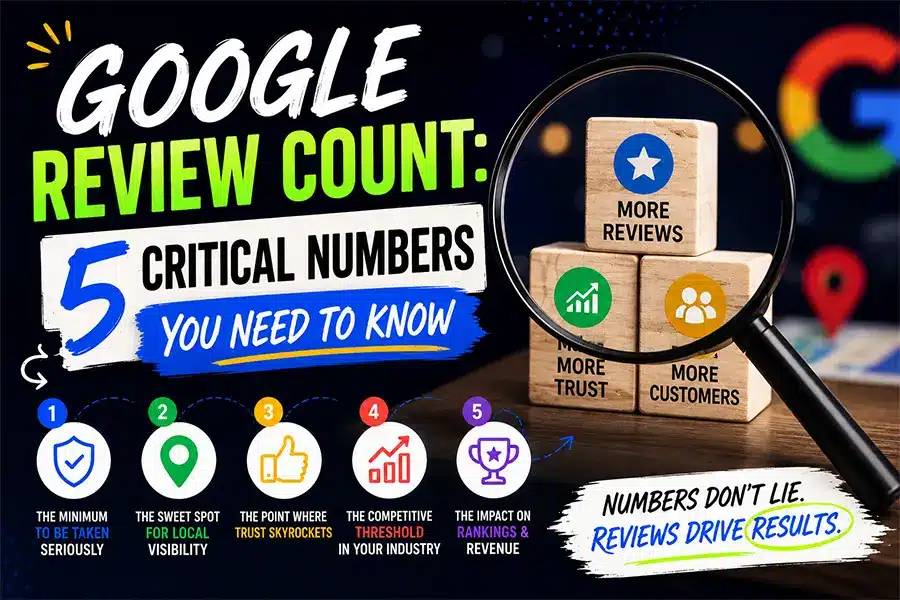
There is no published number of Google reviews you need, and anyone who quotes you one is guessing. Google names review count and score as part of how it judges prominence, but it publishes no threshold and states that ranking details are kept confidential. The number that matters is not an industry average. It is the number the businesses currently sitting in your map pack have, which you can find in about twenty minutes.
Key takeaways
- Google confirms reviews feed the prominence factor but publishes no target number
- Your real target is whatever the three businesses in your map pack currently have
- Recency is now weighted heavily by buyers. 74 percent prioritise reviews from the last three months
- 31 percent of consumers will not consider a business rated below 4.5 stars, so rating is a gate before count matters
- 80 percent are more likely to use a business that replies to all reviews, and 42 percent avoid ones that ignore them
- Be sceptical of any specific review threshold quoted without a named, checkable source
Why nobody can give you a magic number
Google's own documentation on local ranking names three factors: relevance, distance and prominence. It mentions the number of reviews and your review score as things that feed prominence. It does not publish a threshold, and it states directly that it keeps the details of the ranking system confidential to keep it fair.
That matters because review targets are one of the most confidently repeated invented statistics in this industry. You will see precise sounding figures presented as research, usually with no named study behind them. Treat a specific number with no checkable source the same way you would treat a guaranteed ranking promise, which Google also says nobody can deliver.
The honest position is that review count is relative, not absolute. Forty reviews might be dominant in a rural speciality trade and invisible in a competitive urban category. The only comparison that means anything is the one happening in your own search results.
Of consumers read reviews when choosing a local business. Reviews are not a tiebreaker at the end, they are part of the shortlist decision.
BrightLocal Local Consumer Review Survey, 2026Will only consider a business rated 4.5 stars or higher, up from 17 percent the previous year. Rating is now a gate that count cannot get you through.
BrightLocal Local Consumer Review Survey, 2026Prioritise reviews written within the last three months, which is why a large historical total can still read as a business that has gone quiet.
BrightLocal Local Consumer Review Survey, 2026Find your real target in twenty minutes
This is the method we use on every local client, and it beats any published benchmark because it measures the actual competition you are up against rather than an average of businesses that are nothing like yours.
Search as a customer
Use your main service plus your area, on a phone, not logged into your business account. Note the three businesses in the map pack.
5 minutesRecord their numbers
Total review count and star rating for each. Write down the lowest of the three, because that is the realistic entry point, not the highest.
5 minutesCheck their recency
Open each profile and see how many reviews arrived in the last three months. This is usually where the real gap is, not in the totals.
5 minutesRepeat in three suburbs
Distance is a ranking factor, so the map pack changes across your service area. Three checks give you a range rather than one snapshot.
5 minutesSet your target
Aim to reach the lowest total you recorded, at a rating above 4.5, with a steady monthly flow. Recheck quarterly, because the target moves.
OngoingThe four numbers that actually matter
| Number | Why it matters | What to aim for |
|---|---|---|
| Your total against the map pack | Reviews feed the prominence factor, and prominence is judged against the businesses you are competing with | At least match the lowest of the three currently ranking in your area |
| Reviews in the last three months | 74 percent of consumers weigh recent reviews most heavily, so a stale profile reads as a slowing business | A steady monthly flow rather than occasional bursts |
| Your star rating | 31 percent will not consider a business below 4.5 stars, which makes rating a filter applied before count is even seen | Above 4.5, protected by fixing the causes of poor reviews |
| Your response rate | 80 percent are more likely to use a business that responds to all reviews, and 42 percent avoid businesses that ignore them | Reply to every review, including the difficult ones |
Notice that only one of these four is a total. Most businesses obsess over the number and neglect the other three, which is usually where the actual gap is.
What about AI assistants and reviews?
You will see specific review thresholds quoted for getting recommended by ChatGPT, Gemini or Perplexity. We have not found a credible published study establishing any such number, and we are not going to invent one. What is documented is that BrightLocal's 2026 survey found 45 percent of consumers now use AI tools to find local businesses, up from 6 percent, which makes assistants the third most used discovery source after Google and Facebook.
What is also documented is that these systems get business details wrong. A Tow Center study at Columbia Journalism Review found ChatGPT search returned partially or entirely incorrect source attributions for 153 of 200 tested quotes, while admitting uncertainty only seven times. Applied to a local business, that means an assistant can state your hours or services confidently and incorrectly.
The practical response is not to chase an invented review number. It is to keep your business information consistent everywhere, keep reviews flowing and recent, and check monthly what assistants actually say about you. That is covered properly in our guide to AI search optimization.
How to grow reviews without breaking the rules
What works
- Ask at the moment of completion, when satisfaction is highest
- Use a short direct link so it takes one tap on a phone
- Ask every customer, not only the ones who volunteer praise
- Reply to all reviews in plain language, good and bad
- Track new reviews per month, not just the lifetime total
- Treat a slowdown as a problem to fix, like a traffic drop
What risks your profile
- Buying reviews or using review generating services of unclear origin
- Offering discounts or gifts in exchange for a review
- Trading reviews with other local businesses
- Filtering so only happy customers get asked
- Posting reviews from staff, family or your own devices
- Chasing a big burst of reviews in a single week
If your reviews suddenly disappear
It may not be something you did. Search Engine Land reported on July 3 that Google confirmed it was investigating missing reviews and suspended review functionality on local listings after multiple businesses reported problems. Before assuming a policy violation, check whether the reviews returned, and whether other local businesses saw the same thing at the same time.
Frequently asked questions about Google review count
How many Google reviews do I need to rank in the map pack?
There is no published threshold. Google names review count and score as part of the prominence factor but does not state a number, and keeps ranking details confidential. The practical target is to match or beat the lowest reviewed business currently appearing in the map pack for your service in your area.
Is a specific number like 47 or 150 reviews meaningful?
Not unless it comes with a named, checkable source. Precise sounding review thresholds circulate widely in the SEO industry without any published study behind them. Benchmark against your own competitors instead, which takes about twenty minutes and gives you a number that is actually true for your market.
Do older reviews stop counting?
They remain on your profile, but consumer behaviour discounts them. BrightLocal found 74 percent of consumers prioritise reviews written in the last three months. A large total with nothing recent tends to read as a business that has slowed down, regardless of how it is weighted algorithmically.
Is star rating or review count more important?
Rating acts as a gate. BrightLocal found 31 percent of consumers will only consider businesses rated 4.5 stars or higher, up from 17 percent a year earlier. If you are below that line, adding volume does not help until the rating recovers.
How many reviews should I aim to get each month?
Enough that you always have reviews from the last three months, and enough to close the gap with your map pack competitors within a reasonable period. For a business completing a handful of jobs a week, asking every customer usually produces that naturally. Consistency matters more than any target figure.
Can I ask customers to leave a review?
Yes, asking is allowed and encouraged. What is not allowed is incentivising reviews, buying them, or asking only customers you expect to be positive. Ask everyone, at completion, with a short link.
Should I respond to negative reviews?
Always, and calmly. BrightLocal found 80 percent of consumers are more likely to use a business that responds to all its reviews, while 42 percent avoid businesses that ignore feedback. A measured reply to a hostile review often persuades readers more than the positive reviews above it.
Do reviews on other sites matter?
They matter for buyer confidence and for consistency of your business information across the web, which assistants and search engines both use. For map pack visibility specifically, your Google reviews are the ones attached to the profile being ranked.
My reviews disappeared. What happened?
Check whether it was a platform issue before assuming a violation. Search Engine Land reported on July 3 that Google confirmed it was investigating missing reviews and suspended review functionality on local listings after multiple business complaints.
How do reviews fit into everything else?
They are one of the two levers you actually control in local ranking, the other being relevance through your profile and service pages. Distance you cannot change. That makes a review habit one of the highest return activities available to a local business. See our guide to Google Maps SEO for how it fits together.
About this article. Written by the team at FOG Digital Marketing, a San Antonio agency that manages Google Business Profiles and review programmes for local service businesses across South Texas. Our office is at 2822 N Loop 1604 W Suite 109, San Antonio, TX 78248, and you can reach us on (726) 224-4920. Our related service is Google Business Profile optimization.
Sources cited. Google Business Profile Help documentation on improving local ranking; BrightLocal Local Consumer Review Survey 2026; Tow Center for Digital Journalism at Columbia Journalism Review, November 2024; Search Engine Land reporting on missing reviews, July 3.
A note on numbers. This article deliberately avoids quoting a specific review threshold. We could not find a credible published source for the figures commonly circulated, so we have given you a method to find your own instead.

Want to know what your review target actually is?
We will check the map pack across your service area, tell you the review count and rating you are actually competing against, and show you the gap. No cost and no obligation.
Our Blog
Website Design Blogs

WordPress 7.1.3 Fixes 7 Holes: Update Your Site Now
WordPress 7.1.3 Fixes 7 Holes: Update Your Site Now October 20, 2026 Web Design Table of Contents WordPress 7.1.3 fixes seven security holes, and the WordPress team says...

Can an AI Website Builder Build My Business Site?
Can an AI Website Builder Build My Business Site? September 9, 2026 Web Design Table of Contents Yes, an AI website builder can produce a working business website...

Core Web Vitals: Why Slow Sites Are Losing Rankings
Core Web Vitals 2026: Why Slow Sites Are Losing Rankings July 7, 2026 Web Design Table of Contents If your website takes more than 2.5 seconds to show...
One Response