

Table of Contents
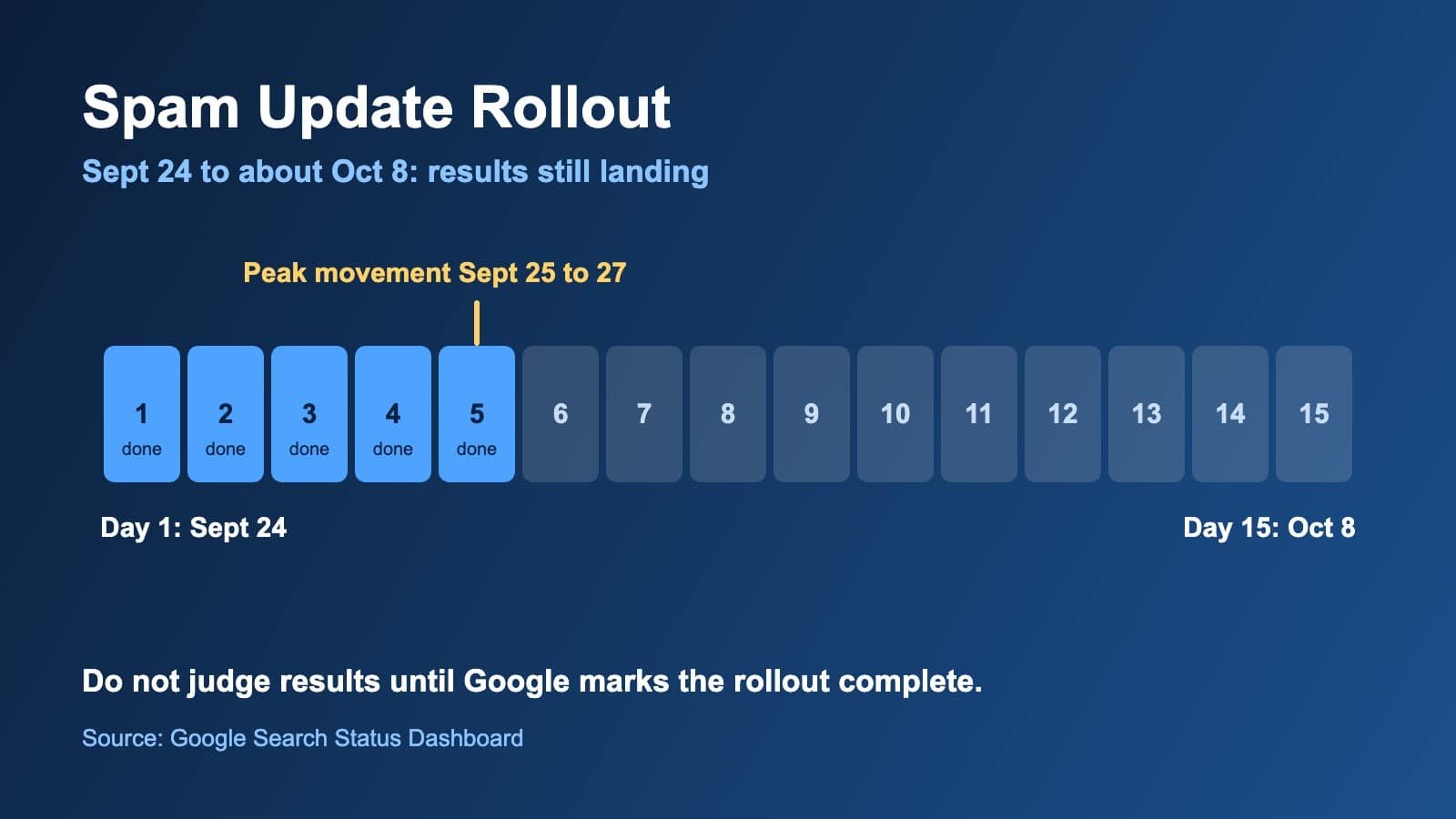
Google’s September spam update rollout began on September 24 and is expected to take up to two weeks, far longer than the two day August update, so your rankings may still be moving right now. Google says the recovery from a spam hit can take many months. That means the choices you make this week, while the spam update rollout is still in progress, matter more than usual.
This is the fourth spam update Google has announced this year, and it is the slowest since June. If you own or manage a business in San Antonio or anywhere else, here is what changed, what is different this time, and exactly what to check before the spam update rollout finishes.
Key Takeaways
- Google released the September 2026 spam update on September 24, 2026 at 9:15 a.m. Pacific, applying globally and to all languages, per Google’s Search Status Dashboard.
- Google says the spam update rollout may take up to two weeks, compared with 2 days and 16 hours for the August 2026 spam update, so ranking changes can keep landing through early October.
- Search Engine Roundtable reported the biggest movement between Friday, September 25 and Sunday, September 27, with more than a dozen volatility tracking tools showing elevated swings.
- SEO analyst Glenn Gabe reported big visibility drops for AI generated and programmatic (template built at scale) sites, across many industries and countries.
- Google’s own documentation says a site may improve only after its automated systems learn over a period of months that it follows the spam policies.
- A spam update rollout has no appeal form. The only fix is removing whatever violates Google’s spam policies, then waiting for the systems to reassess.
What Changed in the September Spam Update Rollout?
Google posted on its Search Status Dashboard incident for the September 2026 spam update that it “applies globally and to all languages” and “may take up to two weeks to complete.” The incident started September 24, 2026 at 9:15 a.m. Pacific time.
A spam update is different from a core update. A core update re-evaluates how helpful your content is overall. A spam update improves Google’s automated spam detection, including its AI based system called SpamBrain, at catching tactics that break Google’s spam policies. The spam update rollout is aimed at manipulation, not at ordinary businesses with ordinary websites.
What makes this spam update rollout unusual is the length. According to Search Engine Roundtable, Google’s John Mueller said this one would likely take longer than some of the previous ones. That is a real change in pattern, and it changes how you should react.
Why Is This Spam Update Rollout Taking So Much Longer?
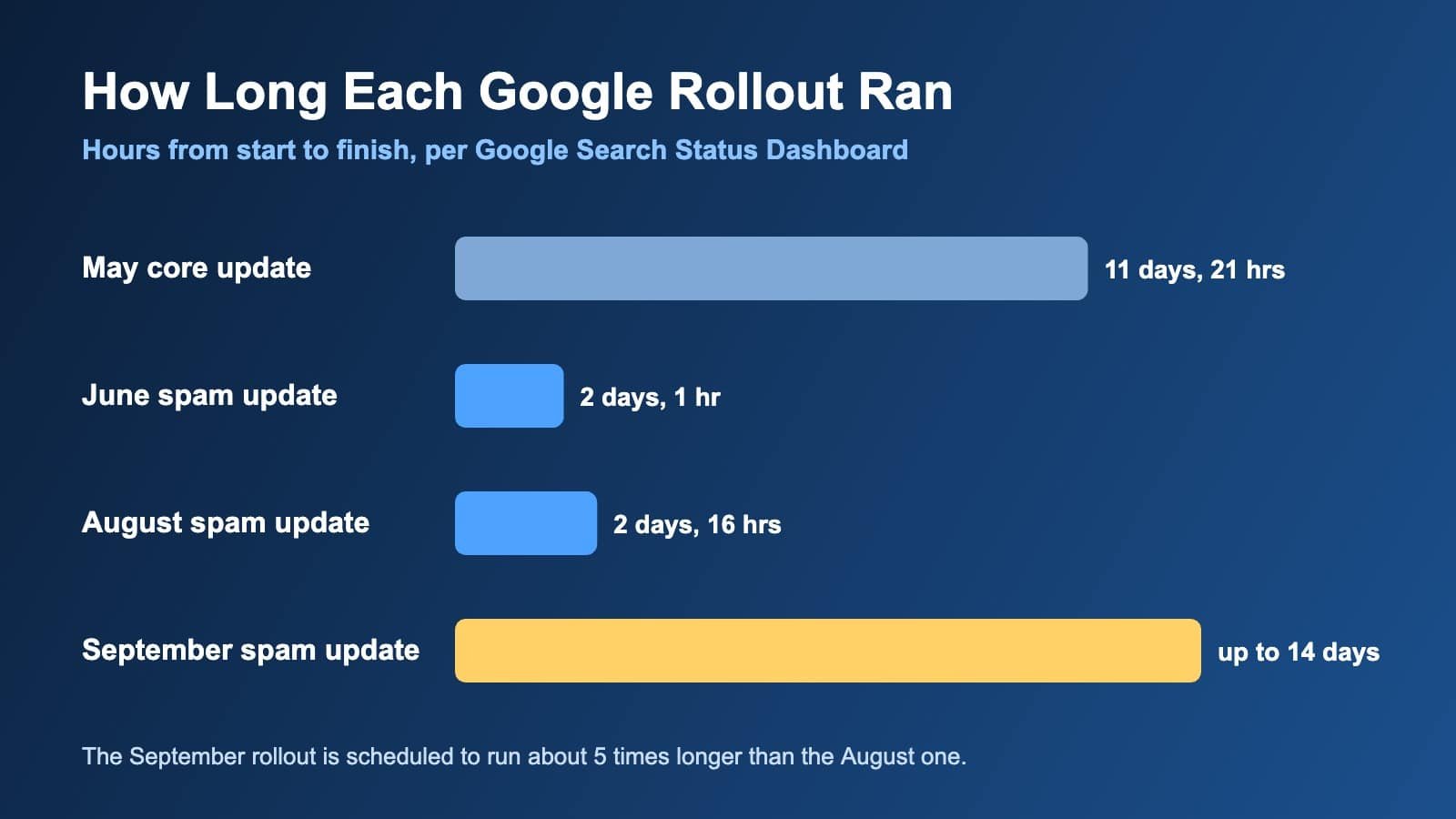
The speed of a rollout tells you how the ranking changes will arrive. Google’s own dashboard shows the pattern across this year’s updates.
| Google Update | Started | Rollout Length | What It Means For You |
|---|---|---|---|
| May core update | May 21 | 11 days, 21 hours | Content quality reassessment |
| June spam update | June 24 | 2 days, 1 hour | Fast, sudden drops |
| August spam update | August 18 | 2 days, 16 hours | Fast, sudden drops |
| September spam update | September 24 | Up to 2 weeks (in progress) | Slow, staggered changes. Do not judge yet. |
Source: Google Search Status Dashboard ranking history, read September 29, 2026. The short spam updates hit like a switch. This spam update rollout behaves more like a tide, where different sites move on different days. If you saw nothing happen on September 25, that does not mean you are safe. It means the spam update rollout has not reached your pages yet, or that nothing on your site triggered it.
Who Is Getting Hit by the Spam Update Rollout So Far?
Search Engine Roundtable’s report on the weekend impact of the September 2026 spam update said the movement was strongest from Friday, September 25 through Sunday, September 27, and that volatility showed up in tools including Semrush Sensor, Mozcast, Sistrix and AccuRanker. The site’s Barry Schwartz wrote that these spam updates seem to have more impact than the older spam updates from years ago.
Glenn Gabe, an SEO consultant who tracks these updates closely, reported big drops across a number of sites, and said AI generated and programmatic sites lost visibility. Programmatic simply means pages produced by a template at scale, such as one page per city with only the city name changed.
Two honest caveats. First, the spam update rollout was only five days old when this was reported, so the picture will change. Second, Google has not said what share of searches are affected or which tactics were targeted, so anyone claiming to know the exact trigger is guessing. If you want to compare with what happened in the last round, we broke down the numbers in our post on how the August spam update erased rankings in just days.
What Should You Do This Week While the Rollout Is Still Running?
The worst move is a panicked rebuild mid rollout. You cannot measure the effect of a change while rankings are still shifting. Follow this sequence instead. At FOG Digital Marketing we run these same steps for San Antonio clients every time Google confirms a spam update rollout.
The 5 Step Spam Update Rollout Plan
Screenshot your baseline today
Export Search Console clicks, impressions and average position for your top 20 pages so you can compare after October 8.
Find pages made at scale
List every city page, service page and blog post that was mass produced or AI written without a human adding real detail.
Audit links someone else built
Ask any past vendor for a list of links they placed. Paid links that pass ranking value break Google’s policy.
Check for hacked or hidden pages
Search site:yourdomain.com and read every result. Outdated plugins often serve spam pages you never see.
Fix, then wait for the rollout to end
Remove real violations now. Judge results only after Google marks the spam update rollout complete.
Step four is the one owners skip. A neglected site can carry spam that only Google sees, and cleaning it is standard website maintenance services work rather than a marketing project. Step two is where a spam update rollout most often catches local service companies, because an earlier agency built dozens of near identical city pages. A proper crawl and page audit falls under technical SEO services.
How Do You Know Whether the Spam Update Rollout Hit You?
Open Google Search Console, set the range to the last 28 days compared with the previous period, and look for a sharp drop starting on or after September 24. Then read the pattern.
- A steep drop on one date: likely the spam update rollout. Move to the audit steps above.
- Impressions steady, clicks falling: probably AI answers absorbing clicks, not spam. Our guide to fixing zero click search losses covers that.
- Only map pack results dropped: a Business Profile issue, since local pack rankings use different signals.
- A message in the Manual Actions report: a human review penalty, which is separate and does have a reconsideration request.
- Nothing changed yet: keep watching until Google marks the spam update rollout finished.
Because Google’s Search Central documentation on spam updates says a site may improve only after automated systems learn over a period of months that it complies, patience is part of the plan. If your rankings have been bouncing for longer than this one update, see our explainer on what to do during Google ranking volatility.
How Do You Stay Visible While Rankings Settle?
Traditional rankings are only one way customers find you. While a spam update rollout runs, protect the other channels. Keep your Google Business Profile accurate, keep publishing pages a real person wrote from real experience, and make sure AI assistants can find and cite you. That last piece is the focus of our AI search optimization service, and it matters more each month, as we explained in how Google AI search changed the way customers find you.
A steady, honest strategy from a San Antonio SEO company beats a reaction to every update. The businesses that come through a spam update rollout well are the ones that never depended on shortcuts in the first place.
Common Mistakes During a Spam Update Rollout
- Changing everything mid rollout. You cannot tell what worked while rankings are still moving. Fix real violations, then wait.
- Deleting pages at random. Removing pages that were never the problem costs you rankings you still had.
- Filing a reconsideration request. An algorithmic spam update has no appeal. That form only applies to manual actions.
- Publishing more AI content to catch up. If scaled content is the trigger, more volume makes the signal stronger.
- Trusting the vendor who caused it. An agency that built the mass produced pages is unlikely to name its own work as the cause.
Frequently Asked Questions
When does the September spam update rollout end?
Google said the spam update rollout may take up to two weeks from September 24, 2026, so it should finish by about October 8. Google will post the completion on its Search Status Dashboard, and that is the point to start comparing your data.Is my website safe if my rankings did not change?
Not necessarily yet. Because this spam update rollout is staggered over up to two weeks, some sites move days after others. Check again once Google marks the rollout complete before concluding you were unaffected.Can I appeal if a spam update hurts my rankings?
No. A spam update rollout is algorithmic, so there is no appeal or reconsideration request. That form only applies to manual actions shown in Search Console. Fix the violation and wait for Google’s systems to reassess.How long does recovery take after a spam update?
Recovery can take many months. Google’s documentation says a site may improve if its automated systems learn over a period of months that the site follows the spam policies, so cleanup is a long game rather than a quick fix.Does AI written content cause a spam update penalty?
Not by itself. Google’s concern is scaled content made mainly to manipulate rankings, and reports from this spam update rollout say AI generated and programmatic sites lost visibility. Content that a real expert reviewed and improved is a different situation.
A slow spam update rollout gives you something rare: time to look honestly at your site before the final results land. Use it to audit, fix what is truly wrong, and keep your customers finding you through every channel while rankings settle.
Did Your Rankings Move Since September 24?
FOG Digital Marketing audits your site for spam policy risks, cleans up what Google may be flagging, and keeps you visible in Google and AI answers. Based in San Antonio.
Our Blog
Website Design Blogs

Can an AI Website Builder Build My Business Site?
Can an AI Website Builder Build My Business Site? September 9, 2026 Web Design Table of Contents Yes, an AI website builder can produce a working business website...

Core Web Vitals 2026: Why Slow Sites Are Losing Rankings
Core Web Vitals 2026: Why Slow Sites Are Losing Rankings July 7, 2026 Web Design Table of Contents If your website takes more than 2.5 seconds to show...

ADA Website Compliance: Critical 2026 Alert for Owners
ADA Website Compliance: Critical 2026 Alert for Owners July 6, 2026 Web Design Table of Contents If your website has a broken form field, low-contrast text, or an...